Issue 01Agentic Legal OS
Powered by Justine | Eve-Legal {F5/reasoner}

Practice law.JustineAI reasons through the rest.

The Agentic Legal OS. Reasoning-first. Attorney-attested. Currently powering personal injury practices — with workers’ comp, medical malpractice, mass tort, insurance bad faith, and employment class actions on the roadmap. Powered by Justine and the Eve-Legal F5/reasoner compound architecture, deployed on Eve-Grid™.

PI edition: 14-day free trial · No credit card required · Cancel anytime. Self-serve access is available for solo and small PI firms; sales-assisted onboarding for mid-size and enterprise.

A day in the practice
Justine — the JustineAI™ Digital Employee
Justine — the Digital Employee for legal work.

You walk in to eighteen open files. By 10:00 a.m. you’re working the case that matters today.

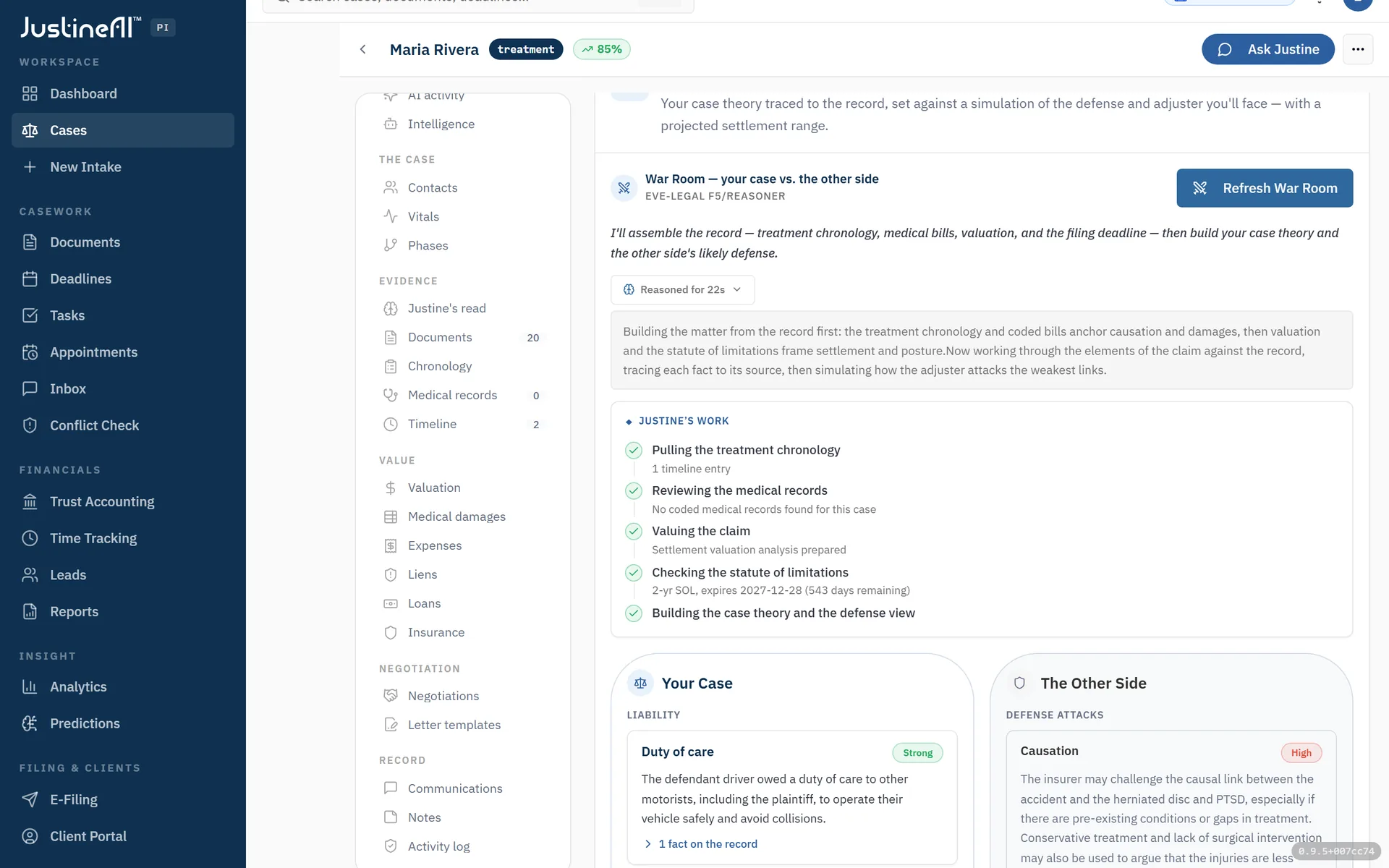
You triage. Justine has already pulled the matters touched overnight — the treatment notes that just hit the chronology, the demand letter draft that came back with adjuster pushback, the deposition you set for Thursday. Each is annotated with what changed, what needs your decision, and what Justine has already lined up for your sign-off.

On the demand letter, Justine has already run the four-pass reasoning pipeline — a draft, a medical-causation pass, a damages-quantification pass, and a four-layer QA check. Every cited statute and case is anchored to CourtListener. You read, mark the two paragraphs you want sharpened, and approve. The letter is filed before lunch.

The 5,000-page record set is no longer the day’s blocker. Justine has chronologied it across providers, surfaced the treatment gaps the carrier will exploit, and flagged the three exam notes that contradict the IME. You decide what to do with each finding. The AI reasons; the attorney decides.

You sit down to think. Not to type.

In the same workspace, Justine has already reconciled the morning’s trust-account activity, flagged a conflict on the new intake from yesterday afternoon, e-filed the answer due in another matter, and surfaced two deadlines coming due next week. The case file is one tab. The deadline engine, the conflict-check ledger, the trust-accounting reconciliation, the time tracking, the client portal, the integrations with Microsoft 365 and Filevine — all of them are different tabs in the same operating system. JustineAI™ runs the firm, not just the demand letter.

Read the PI workflow in full →

Watch Justine work a fileIntake to briefing

One file. Six stages of reasoning. One context.

Drop a matter on Justine and the work begins. A supervisor coordinates stage-specialized sub-agents — intake, medical, valuation, strategy, deposition — and reasons across the entire case file in a single 10M-token context. Here is what happens, in order, before the file reaches your desk.

  1. Intake sub-agent

    Drop the file.

    A new matter lands — the police report, the ER intake form, the carrier’s declaration page, five thousand pages of records. Justine reads every page in a single context and routes the work.

    Justine found — the jurisdiction, the at-fault carrier, and the layered UM/UIM coverage — each with the source page behind it, and a validator council confirming the statute-of-limitations clock before anything else runs.

  2. Curation Layer + Medical sub-agent

    Clean the record, build the chronology.

    Nine curation modules canonicalize providers, validate ICD-10 / CPT codes, split incident dates, and coalesce encounters — so the reasoning runs on a clean record, not raw scans.

    Justine found — across nine providers, the 19-day treatment gap the carrier’s IME will exploit, the two physical-therapy notes that contradict its functional-capacity opinion, and the records that establish causation back to the collision.

  3. Valuation sub-agent

    Value the matter.

    Special and general damages, venue comparables for the specific injury, and lien-versus-policy math — assembled into a number you can defend.

    Justine found — special damages, venue comparables for an L4–L5 disc herniation, the lien total against the available policy and UM coverage, and a pre-suit demand with a bottom-line authority — every figure traceable to its source.

  4. Strategy + Deposition sub-agents

    Stress-test the theory.

    Justine argues the other side’s case before opposing counsel does — what the IME will claim, where liability is soft, which sworn answers contradict the record.

    Justine found — three inconsistencies between the defendant’s deposition and his Day-1 recorded statement, and a cross-examination sequence built from his own prior words.

  5. Demand pipeline

    Draft, then ground every word.

    A four-pass demand-letter pipeline drafts the narrative, validates each code, and grounds every statute and case against a verifiable authority on CourtListener — reasoned from real law, never invented.

    Justine found — a one-click Demand Package — cover letter, Medical Chronology, and Bill Stack — with the conflict check run and cleared before the engagement letter ever went out.

  6. Case Advisor + Justine, supervising

    Brief the attorney.

    At 06:00 the matter surfaces in your briefing — what changed overnight, what needs your decision, and the statute deadline 21 days out — alongside the other matters that need you today.

    Justine found — a viability score of 85/100, the full reasoning trail behind it, and the entire package queued for your sign-off.

Six stages, one context — the work ready before your first coffee. You decide what happens next.

Watch it play through, step by step →

The reasoning, shownAttorney-attested work product

This is the reasoning — not just the workflow.

The case-reasoning quality that used to be locked inside elite firms, on every matter. These are the kinds of findings Justine surfaces on a real file — the contradictions, the comparables, the deadlines a busy practice would miss — each one presented with its evidence, its confidence, and the source behind it, for your review.

  • Intake reasoning

    Justine found — Drop the police report, the ER intake form, and the carrier’s declaration page. Justine reads every page, extracts the jurisdiction, the at-fault carrier, and the layered UM/UIM coverage — and shows the source page behind every value, with a validator council confirming the statute clock before assembly.

  • Medical chronology

    Justine found — Across 5,000 pages and nine providers: the 19-day treatment gap the carrier’s IME will exploit, the two PT notes that contradict its functional-capacity opinion, and the three records that establish causation back to the collision.

  • Case valuation

    Justine found — Special damages $87K. Venue comparables for an L4-L5 disc herniation in San Diego County run $180K–$320K. Lien total $42K against a $100K policy plus $250K UM. Pre-suit demand: $385K. Bottom-line authority: $215K.

  • Deposition analysis

    Justine found — Cross-referenced the defendant’s Day-3 deposition against his Day-1 recorded statement and the police report — three inconsistencies on speed and following distance, and a ready cross-examination sequence built from his own prior words.

  • Negotiation strategy

    Justine found — When the demand leads with future-medical and a sworn provider affidavit, this adjuster’s own claim history shows a markedly higher rate of settling soft-tissue cases under policy limit. Justine framed the opening number 15% above the projected acceptance range — with the supporting authority already attached.

  • Viability + deadlines

    Justine found — Scored the matter 85/100 — citing both treating physicians, a clean liability picture, and a statute-of-limitations deadline 21 days out — and surfaced it in the 06:00 briefing alongside the two other matters that need you today.

  • Conflict + citation discipline

    Justine found — Caught a prior representation of the opposing driver before the engagement letter went out. And every statute and case Justine cites is grounded against a verifiable authority on CourtListener — reasoned from real law, never invented.

The AI reasons; the attorney decides.

The intelligence, in numbersEvery figure code-anchored

Capability you can measure.

Not marketing estimates — figures anchored to the architecture itself. This is what it takes to reason over an entire case file at once, and what keeps that reasoning grounded in real law.

10Mtokens · one context

The entire case file, read in one thought.

Every record, every deposition, every motion — reasoned together in a single 10M-token context. Full-case-file review and multi-deposition synthesis become one-shot queries, not weeks of paralegal time.

5cooperating models

A compositional fabric, not one model.

Eve-Legal F5/reasoner composes a classifier, a legal reasoner fine-tuned on synthetic law, frontier reasoning slots, and a long-context model — assembled per matter, never as a fixed ensemble.

50states + DC

Every US jurisdiction, hand-curated.

Personal-injury rules are curated for all fifty states plus DC. Ten top-PI states carry case-law citation packs anchored to CourtListener — grounded authority, no hallucinated case law.

100%synthetic training data

Your firm’s data never trains the model.

Eve-Genesis (Law Edition) — the dataset behind the legal reasoner — is 100% synthetic by construction. Your matters stay in your tenant. Nothing you upload is used to train anything.

One core. Six editions.

One reasoning core. One edition in market. Five more on the way.

Eve-Legal F5/reasoner is shared across every JustineAI™ edition. What changes is the domain calibration — the workflow, the document pipeline, the jurisdictional rules — not the underlying compositional fabric. The supervisor pattern that powers PI is the same pattern that will power mass tort at scale.

Build vs buyThe function you replace

Operate a personal-injury practice at full firm capacity with the headcount of one.

A typical PI practice’s case-management, intake, and medical-records review function runs between $300K and $600K per year for a solo practice: a paralegal at $80K, a case manager at $70K, an intake firm at $30–80K, a medical-records-review service at $50–150K, plus tooling and overhead. JustineAI delivers the same operational capability at a fraction. The attorney remains the strategist; the platform absorbs the time-sink that used to define solo practice.

Solo PI practice

$300K – $600K / yr

Paralegal + case manager + intake firm + medical-records-review service, fully loaded

Per-attorney leverage

10× case load

One attorney with Justine working the docket a 10-attorney firm used to handle

JustineAI

Fraction of in-house

Per-attorney pricing. Attorney remains the strategist; the platform absorbs the time-sink.

The architectureEve-Legal™ Fusion v5

The reasoner orchestrates. The frontier consults.

Every JustineAI™ edition runs on Eve-Legal™ Fusion v5 — a compositional fabric, not a stack. One Microsoft Phi-3 classifier, one Eve-Legal™ F5/reasoner trained on Eve-Genesis™ (Law Edition), three frontier slots composed per request. The reasoner owns the request; the frontier models consult.

Where a jurisdiction or client prohibits a specific provider, that provider is swapped without rebuilding the agent. Provider-agnostic by design.

CLASSIFIERMicrosoft Phi-3

Routes each request to the right depth — quick lookup versus deep investigation — in under a second. The first responder of the architecture; decides which downstream models compose for the query at hand.

REASONEREve-Legal™ F5/reasoner — a Microsoft Phi-4-derived Small Reasoning Model, LoRA fine-tuned on Eve-Genesis™ (Law Edition)

The law reasoner. Trained on a synthetic reasoning dataset built from canonical law methodology — specifically the reasoning modes the discipline actually uses (analogical, abductive, dialectical). The orchestrator: scaffolds the reasoning structure, delegates sub-problems to the frontier slots as consultants, synthesises the final answer in the discipline’s idiom. No customer data in training.

FRONTIER SLOTSThree frontier models · best-fit per release

Three frontier models composed dynamically per request — one for deep synthesis and judging, one for alternative reasoning paths, one for long-context analysis. Provider-agnostic by design; any model can be swapped without rebuilding the agent. The frontier models work for us, not the other way around.

We don’t compete with frontier labs on foundation-model capability. We compose frontier models into our reasoning systems. Eve-Genesis™ training data is 100% synthetic by construction — no customer conversation is ever used to train a model.
One core, every practicePI today · five on the way

The same reasoning, calibrated to each practice.

Eve-Legal F5/reasoner is shared across every JustineAI™ edition. The supervisor + sub-agent pattern that runs personal injury today is the same pattern that scales to thousands of plaintiffs in mass tort. What changes per edition is the calibration — the workflow, the documents, the jurisdiction — never the reasoning core.

  • PIIn marketJustineAI™ PI

    Reads the full medical record, builds the chronology, values the matter against venue comparables, and drafts a demand grounded on verifiable authority — across the nine-status case lifecycle.

  • MTComing nextJustineAI™ MT

    One Justine supervisor will coordinate thousands of plaintiff sub-agents in a single context — bellwether scoring, settlement-matrix modeling at scale, lien negotiation across the whole inventory. The pattern that runs one PI file is the pattern that runs ten thousand.

  • WCComing nextJustineAI™ WC

    Will reason over AME / PQME analysis, MMI tracking, and MTUS / ACOEM utilization review — with ChironAI™ Occupational Medicine as the upstream clinical feed. Cross-portfolio reasoning a single-vertical vendor cannot reach.

  • MMOn the roadmapJustineAI™ MM

    Will carry multi-provider chronology across 5,000–50,000 pages, causation reasoned against cited standard-of-care deviations, Daubert preparation, and certificate-of-merit drafting.

  • IBOn the roadmapJustineAI™ IB

    Will run policy-language interpretation, claim-file analysis, and prior-claim pattern detection across the carrier’s entire portfolio — the reasoning that turns a denial into a bad-faith case.

  • ELOn the roadmapJustineAI™ EL

    Will handle class-certification practice, damages modeling at class scale, and FLSA fluctuating-workweek math across opt-in collectives.

PI is in market today. Mass tort and workers’ comp are next; medical malpractice, insurance bad faith, and employment class actions are on the roadmap. One reasoning core travels to all of them.

Bounded agencyNever full autonomy

Bounded agency. Never full autonomy.

Agentic AI Operating Systems sit between low-agency helpers (Copilots, RAG chatbots) and high-agency autonomous agents (auto-GPT-shaped systems). They act, but the discipline’s expert remains the decider on every consequential output.

  1. 01

    The product

    An Agentic AI Operating System — a Digital Employee that does the work of cognition alongside the discipline’s human workforce.

  2. 02

    The posture

    Bounded agency. The OS acts within delegated authority. The human remains the consequential decider.

  3. 03

    Why we can extend agency safely

    Because the reasoning is trustworthy. Reasoning the team trusts because the team trained it.

  4. 04

    Why the reasoning is trustworthy

    Eve-Genesis. Reasoning-style conditioning. The reasoner is shaped in the discipline’s cognitive operations, not glued onto a generalist model.

The motto for this product

The AI reasons. The attorney decides.

The attorney remains the consequential decider. The platform does the work of cognition that supports the decision. The line between agency and autonomy is drawn there, on purpose.

What JustineAI does

Intakes the case, structures the file, sequences the workflow, drafts the demand package, indexes the medical records, surfaces the case law.

What the attorney does

Owns the matter, accepts the engagement, signs every filing, advises the client, exercises the attorney’s professional judgement.

The market sorts AI products into two categories. Helpers — Copilots, ChatGPT plugins, RAG chatbots — are useful but not products in the institutional sense. They assist; they do not run anything. Autonomous agents — auto-GPT-shaped systems, fully self-directing — are technologically impressive but procurement-unsafe in regulated verticals. The liability surface is unacceptable. The institutional buyer cannot deploy them.

MindHYVE sits in a third position. Bounded agency. Enough agency to be a real product — a Digital Employee that does the work of cognition. Bounded enough to be safe for deployment in healthcare, education, law, theology — verticals where autonomy is structurally unacceptable and helpers are inadequate to the job.

That third position is structurally hard to take. It requires reasoning the institution actually trusts. Eve-Genesis is what makes the trust earnable. Without the trust substrate, an institution can deploy a helper but not an operator. With it, an institution can deploy an operator that remains under human consequential control.

The equalization mission

“Any litigator with JustineAI now has access to the case-reasoning quality that used to be locked inside elite firms.”

Bill Faruki
CEO, MindHYVE.ai™
The MindHYVE™ founder’s thesis for what the Agentic Legal OS is for.
Trust at a glance

Built for legal procurement.

  • Data discipline

    No customer data used for training.

    Eve-Genesis (Law Edition) — the dataset that fine-tunes the legal reasoner inside Eve-Legal F5/reasoner — is 100% synthetic by construction. Your firm’s data stays in your tenant.

  • Privilege posture

    Attorney-client privilege is preserved by design.

    JustineAI™ is structured to operate under the supervision of the attorney of record. Outputs are work product. Audit logs record the actions taken, the reasoning behind them, and document revisions.

  • Cloud foundation

    Deployed on Eve-Grid™ — Microsoft Azure.

    JustineAI™ runs on Eve-Grid™, our proprietary cloud architecture on Microsoft Azure. The marketing site is hosted on Azure Static Web Apps; the PI application runs on Azure Container Apps with PostgreSQL, Blob Storage, and Key Vault. ISO 27001, ISO 27018, SOC 1/2/3, PCI DSS, and HITRUST attestations are inherited at the platform layer from Microsoft Azure.

  • Audit trail

    Audit logging of every action.

    User actions, and the reasoning behind them, are written to a structured tenant audit log with actor identity, timestamp, and action type — then signed and moved to long-term storage after 90 days. Logs are retained for the agreed contractual period and exportable for litigation discovery and ethics audits.

  • Accessibility

    WCAG 2.1 AA conformance posture.

    Every shipping surface targets WCAG 2.1 AA from day one. Accessibility is a launch criterion, not a roadmap item — keyboard navigation, screen-reader semantics, contrast ratios, focus indicators, and reduced-motion preferences are all built in.

  • Jurisdiction

    50 states plus DC.

    PI jurisdiction rules are hand-curated for every US state plus DC. Ten top-PI states carry curated case-law citation packs anchored to CourtListener — no hallucinated case law.

The motto

The AI reasons; the attorney decides.

JustineAI™ produces structured analytical output with evidence presented openly, reasoning visible at every step, confidence calibrated, every citation grounded. The attorney of record decides what to file, what to argue, and how to advise. Structured workflows. Auditable by design. Work product, not advice — until you sign it.

The MindHYVE portfolioVertical depth on shared cognitive infrastructure

Vertical depth on shared cognitive infrastructure.

One reasoning architecture. Four editions in production — ten across the roadmap. Four genuinely-specialised Agentic AI Operating Systems running across four regulated verticals.

  • Agentic Learning OS

    ArthurAI™

    For institutions that teach — K-12 districts, universities, vocational training authorities, corporate L&D.

    Reasoning modes

    analogical · Socratic · phenomenological

    Motto

    The AI reasons. The educator decides.

    Visit ArthurAI
  • Agentic Healthcare OS

    ChironAI™

    For practices and health systems — reasoning-first clinical decision support and occupational medicine.

    Reasoning modes

    abductive · analogical

    Motto

    The AI reasons. The clinician decides.

    Visit ChironAI
  • Agentic Theology OS

    TheoAI™

    Evidence-grounded Islamic scholarship — every answer traces to a graded chain of transmission.

    Reasoning modes

    dialectical · hermeneutic

    Motto

    The AI reasons. The scholar decides.

    Visit TheoAI

Each product is a genuinely-specialised reasoner trained on its own Eve-Genesis edition. Same architecture. Different cognitive shape. One company that can credibly serve institutions across four regulated verticals — because the methodology that produces each reasoner is shared, and the application of it is not.

The MindHYVE™ family

One parent. Four shipped Agentic Operating Systems. One research corpus.

JustineAI™ is one of four Agentic Operating Systems in the MindHYVE.ai™ portfolio. Each product line is operated by its own per-vertical LLC, all wholly owned by MindHYVE.ai, Inc. The Eve-Fusion™ compound architecture, the Eve-Grid™ cloud, and the Eve-Genesis™ synthetic-data substrate are shared across every product.

Agentic Operating Systems
  • Agentic Legal OS

    JustineAI™(this site)

    For litigation practices — Personal Injury in market today, with workers’ comp, medical malpractice, mass tort, insurance bad faith, and employment class actions on the roadmap.

  • Agentic Learning OS

    ArthurAI™

    For institutions that teach — K-12 districts, universities, vocational training authorities, corporate L&D. Four editions in market.

  • Agentic Healthcare OS

    ChironAI™

    For practices and health systems — reasoning-first clinical decision support and occupational medicine. Two editions in market.

  • Agentic Theology OS

    TheoAI™

    Evidence-grounded Islamic scholarship — every answer traces to a graded chain of transmission.

Research surfaces
  • Islamic Primary Source Corpus

    IPSC™

    Computationally-graded hadith corpus. 449,285 hadith from 86 classical works, every chain parsed, every narrator identified, every grade derived from documented inputs.

Ready when you are

See JustineAI in your practice.

For PI principals, managing partners, and litigation operators evaluating reasoning-grade AI for their firm. Self-serve trial available for solo and small practices; sales-assisted for mid-size and enterprise.