JustineAI™ — Workers’ Comp Edition.
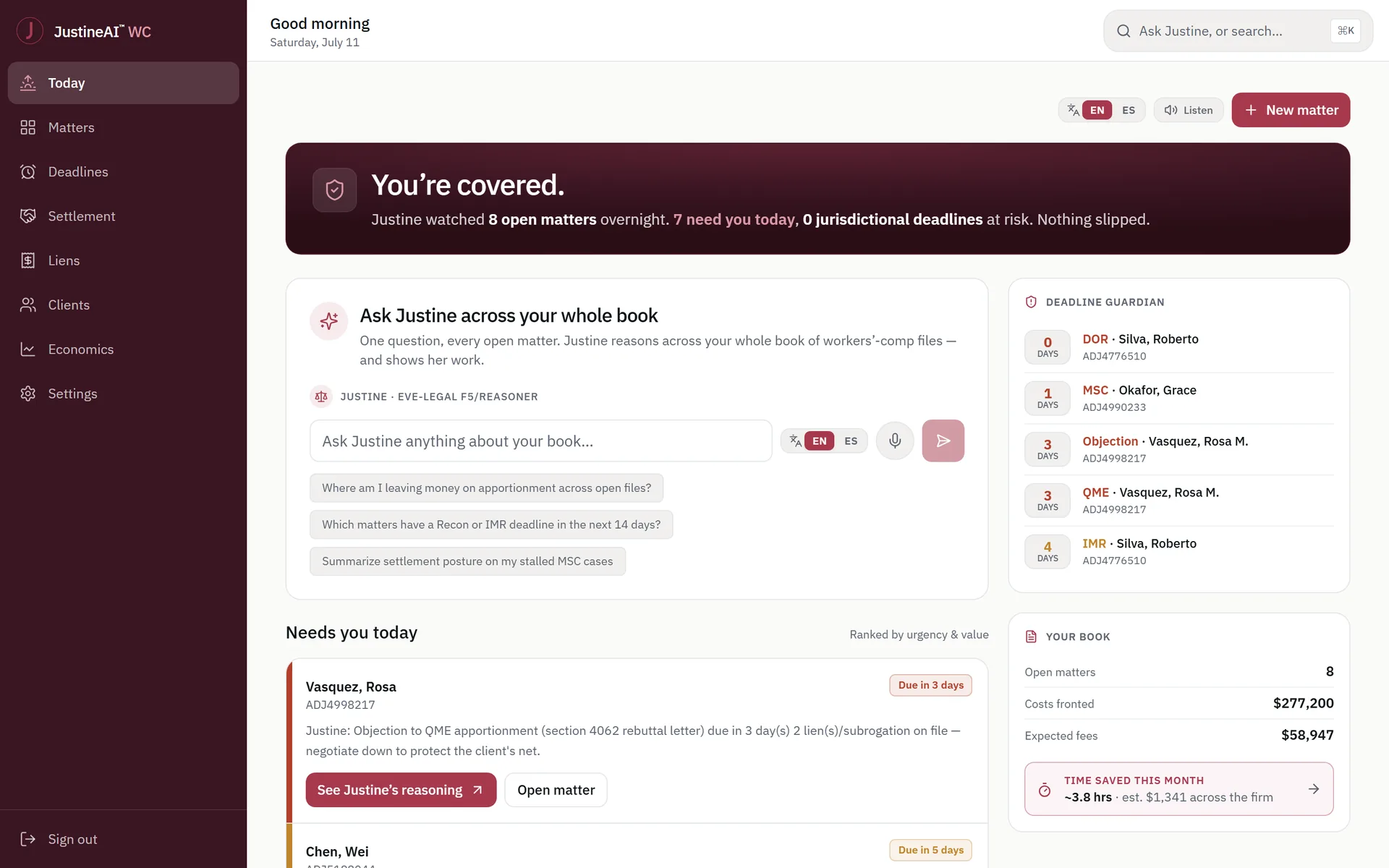
Applicant and defense workers’ comp. State-specific filings, AME/PQME analysis, MMI tracking, MTUS/ACOEM treatment-utilization review, permanent-impairment rating modeling. ChironAI™ Occupational Medicine is the upstream feed — cross-portfolio moat.
WC inherits the full Eve-Legal Operating System — case management, deadlines, conflict check, trust accounting, time tracking, e-filing, e-signature, client portal, Microsoft 365 and Filevine integration. The OS layer is shared across every edition; only the legal-reasoning calibration changes.
This edition is not yet generally available. The page describes the workload it will serve and lets workers’ comp attorneys register interest. We don’t publish dates — we publish the architecture and reach out when the edition is ready.
Nine stages. One Justine. The full workers’ comp lifecycle.
This is the lifecycle JustineAI™ WC is designed to run end to end — the same supervisor pattern that runs personal injury today, recalibrated for workers’ comp practice. Every stage will be auditable, every output attorney-attested work product.
- Stage 01Intake & compensability
When it opens, Justine will run conversational intake against the workers’-comp schema — date of injury, employer and carrier, body parts, AOE/COE compensability vectors, prior claims, and the statute clock. She is designed to flag cumulative-trauma exposure windows and post-termination defenses before the application is filed.
- Stage 02Claim filing
Justine will assemble the state-specific filing taxonomy — a CA DWC-1 and Application for Adjudication, a NY C-3, an FL petition, a TX DWC-41 — populated from intake with per-field provenance. Each form is designed to surface to the attorney for attestation before service, never auto-filed.
- Stage 03Treatment & utilization review
The daily case auditor is designed to track every authorized treatment request against MTUS and ACOEM guidelines, flagging UR denials, IMR appeal deadlines, and out-of-MPN care. When a denial turns on a guideline deviation, Justine will surface the exact guideline section the carrier relied on.
- Stage 04AME / PQME analysis
Justine will parse AME and PQME reports for impairment ratings, apportionment opinions, and causation findings — flagging where the evaluator departs from the record or from MTUS. When the treating provider runs ChironAI™ Occupational Medicine, those assessments are designed to flow upstream into the matter automatically.
- Stage 05MMI & impairment rating
Justine is designed to watch every active matter for Maximum Medical Improvement signals across treating providers and surveillance, then model the permanent-impairment rating against AMA Guides 5th or 6th. The rating string will be cross-checked, with apportionment carved out before the attorney certifies it.
- Stage 06Benefit & PD calculation
Justine will compute the benefit ladder — temporary disability, the permanent-disability award net of apportionment, life-pension thresholds, and accrued penalties for late indemnity. State PD schedules and age/occupation adjustments are designed to be applied per jurisdiction, with every figure traceable to its statutory basis.
- Stage 07Settlement conference
Ahead of a mandatory settlement conference, Justine is designed to assemble the pre-trial statement, model the defense’s exposure range, and surface the carrier’s settlement posture on comparable AOE/COE disputes. The attorney walks in with the valuation, the gaps, and the opposing arguments already mapped.
- Stage 08MSA & settlement
Justine will structure the resolution — Compromise & Release or Stipulations with Request for Award — and prepare the CMS Medicare Set-Aside submission with allocation modeling where Medicare’s interests are implicated. The MSA arithmetic is designed to be reconciled against the rated future medical before signature.
- Stage 09Closeout & compliance
On resolution, Justine is designed to deliver the final file, export the audit log for ethics review, and track post-settlement MSA reporting and seeded-account compliance. The matter closes; the apportionment patterns and carrier behavior the firm learned from it feed its internal library.
One Justine. Sub-agents built for workers’ comp attorneys.
The WC edition will run the same architecture as PI: one Justine coordinating stage-specialized sub-agents across the matter, reasoning in a single context. The sub-agents aren’t separately branded — they’re facets of the Digital Employee. These are the ones this edition is designed around.
- Compensability sub-agent
AOE/COE analysis. Cumulative-trauma date-of-injury vectors. Going-and-coming and personal-comfort exceptions. Post-termination and statute-of-limitations defenses. Employer/carrier identification. Concurrent-employment earnings. Prior-claim apportionment exposure.
For example — A warehouse picker files for a cumulative lumbar injury after termination. You drop the personnel file, the panel QME report, and three years of pay records. The compensability sub-agent will fix the CT date-of-injury under the last-injurious-exposure rule, flag the post-termination defense the carrier will assert, surface a prior 2019 lumbar claim that opens an apportionment argument, and compute the average weekly wage across two concurrent employers — each value traced to its source page.
- Medical sub-agent
Treating-provider chronology. UR / IMR tracking against MTUS and ACOEM. AME/PQME impairment and apportionment review. MMI signal detection. Causation linkage. ICD-10 mapping. ChironAI™ OM upstream assessment ingestion.
For example — A 4,000-page file across an orthopedist, a pain-management group, and a panel QME. The medical sub-agent will surface the UR denial of a lumbar fusion that deviated from MTUS chronic-pain guidance, the IMR appeal window closing in eleven days, and the contradiction between the PQME’s 8% whole-person impairment and the treating surgeon’s range-of-motion measurements supporting a higher rating — with the apportionment opinion isolated for the attorney’s review.
- Rating sub-agent
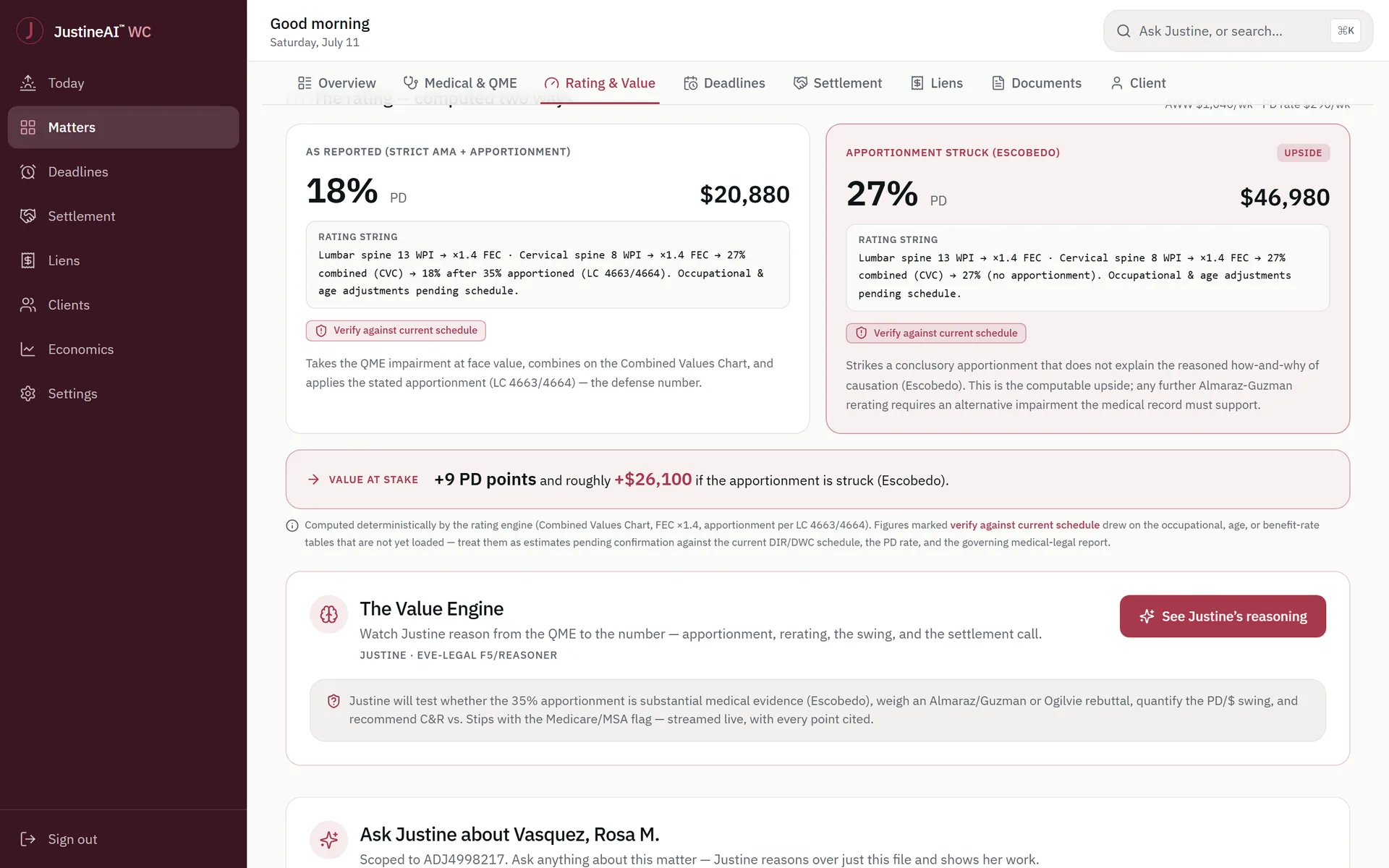
Permanent-impairment rating under AMA Guides 5th / 6th. PD rating-string construction. Apportionment carve-out. Temporary- and permanent-disability indemnity math. Life-pension thresholds. State PD schedules and age/occupation modifiers.
For example — A shoulder injury with a 12% whole-person impairment from the AME. The rating sub-agent will build the California rating string — impairment number, FEC or 2013 PDRS adjustment, occupational variant, and age modifier — model the permanent-disability award, then carve out the 25% apportioned to a pre-existing rotator-cuff tear, netting the payable PD. It will flag that the adjusted rating crosses the 70% life-pension threshold for the attorney to confirm.
- Resolution sub-agent
C&R versus Stipulations modeling. Defense exposure valuation. Mandatory-settlement-conference positioning. Medicare Set-Aside allocation. Open-future-medical liability. Carrier settlement-posture patterns on comparable disputes.
For example — An accepted back-and-knee claim with disputed future medical. The resolution sub-agent will model a Compromise & Release against Stips-with-open-medical, project the CMS Medicare Set-Aside allocation from the rated future treatment, and price the temptation to leave future medical open. Against this carrier’s posture on comparable lumbar disputes, it will recommend a C&R with a seeded MSA and frame an opening figure above the projected acceptance range — authority attached.
The WC workload — described before it ships.
What follows is the architectural commitment for this edition — the workload Eve-Legal F5/reasoner will carry once we open it. The reasoning core is shared with PI. The calibration, taxonomy, and document pipeline are WC-specific.
- AME / PQME analysis
Independent medical examiner reports parsed for impairment ratings, apportionment opinions, and treatment recommendations — with deviations from MTUS / ACOEM flagged.
- MMI tracking
Daily case auditor watches every active matter for Maximum Medical Improvement signals across treating providers and surveillance evidence.
- State-specific filings
CA DWC 5021 / PR-2 / PS-MMI, NY C-4, FL DWC-25, TX DWC-69 and the equivalents elsewhere. State taxonomy curated, not pattern-matched.
- Permanent-impairment rating modeling
PI rating projections grounded in AMA Guides 5th / 6th and state-specific calibrations. PD ratings cross-checked against rating-string lookups.
- Medicare Set-Aside coordination
CMS MSA submission preparation, allocation modeling, and post-settlement compliance tracking — handled inside the supervisor’s workflow, not bolted on.
- ChironAI™ Occupational Medicine upstream feed
When the treating provider runs ChironAI™ OM, the AME / PQME / MMI assessments flow into JustineAI™ WC automatically. Cross-portfolio reasoning, not a hand-off.
The same depth of reasoning — on workers’ comp matters.
We proved the reasoning on personal injury. Here is what the same compositional fabric is designed to surface once the WC edition opens — the findings a workers’ comp practice would want caught, each presented with its evidence for the attorney to weigh.
- Compensability analysis
Justine will surface — On a typical cumulative-trauma matter, Justine will fix the date of injury under the last-injurious-exposure rule, surface the going-and-coming defense the carrier is poised to raise, and flag a prior accepted claim to the same body part that opens an apportionment argument — each tied to the record page that grounds it, for the attorney to weigh.
- Utilization-review defense
Justine will surface — Justine is designed to catch that a UR denial of a lumbar fusion rested on a misread of the MTUS chronic-pain guideline, that the IMR appeal window closes in nine days, and that the requesting physician’s report already contains the documentation the reviewer claimed was absent — the appeal half-drafted from the record itself.
- AME / PQME scrutiny
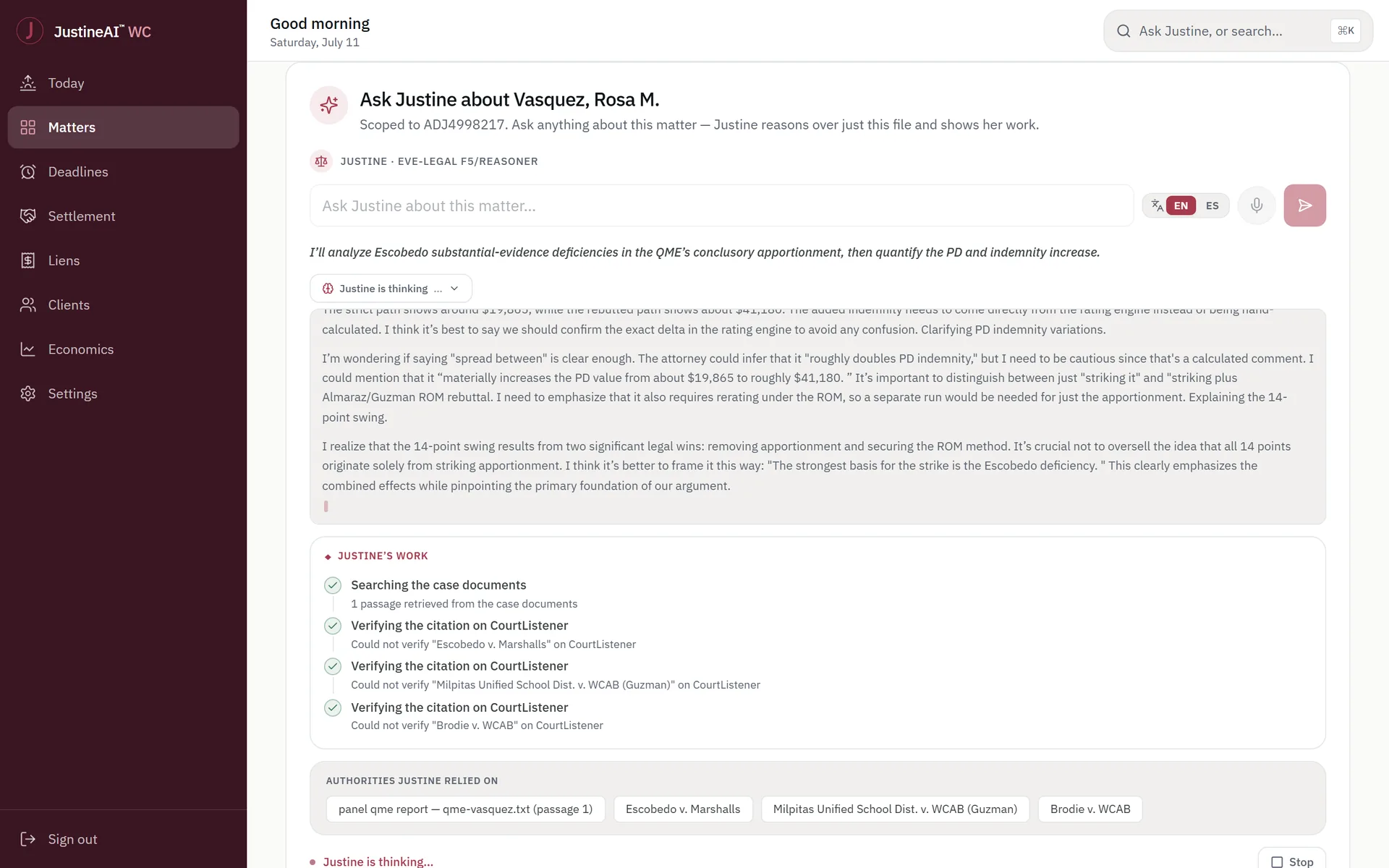
Justine will surface — Across a panel QME report, Justine will surface that the evaluator apportioned 40% to non-industrial degeneration without citing a supporting study, that the impairment number understates the documented range-of-motion loss, and that a prior consistent treating opinion contradicts the apportionment — assembling the cross-examination the attorney can run at deposition.
- Impairment-rating modeling
Justine will surface — On a shoulder injury rated at 12% whole-person, Justine is designed to build the full rating string — occupational variant and age modifier applied — model the permanent-disability award, carve out the apportioned share, and flag that the adjusted rating sits one point below a benefit-tier boundary worth contesting on a stronger range-of-motion reading.
- Benefit calculation
Justine will surface — Justine will compute that temporary-disability indemnity was underpaid for six weeks at the wrong average-weekly-wage because concurrent employment was omitted, that a self-imposed penalty has accrued on the late permanent-disability advances, and that the projected award crosses the life-pension threshold — every figure traceable to its statutory basis for the attorney’s sign-off.
- Citation discipline
Justine will surface — Justine is designed to ground every statute and decision it cites against a verifiable authority on CourtListener — reasoned from real law, never invented — and to catch a prior firm representation of the employer before the engagement letter goes out. The conflict and the citations surface for the attorney, who decides.
The AI reasons; the attorney decides.
Tell us about your WC practice.
We onboard new editions in waves. When WC opens, founding-firm slots and beta access go to attorneys who told us about their practice early. The form tags your inquiry as WC automatically — you don’t need to repeat the practice area.
Solo and small WC practices: we will reach out the moment self-serve opens. Mid-size and enterprise: we will schedule a discovery call in the wave-prep window before general availability.