JustineAI™ PI · Eve-Legal {F5/reasoner}

Personal injury. Settle faster, with a complete record.

JustineAI™ — Personal Injury Edition runs your case lifecycle end to end. Intake through investigation, treatment tracking, demand-letter pipeline, negotiation, settlement. Reasoning-first. Attorney-attested. Designed for plaintiff-side practices working on contingency.

Justine — the JustineAI™ Digital Employee
Personal InjuryIn market
The PI workflow, end to end

Nine statuses. One Digital Employee. The full case lifecycle.

The workflow is the workflow your firm already runs. Justine doesn’t replace it — she runs it with you. Every status is auditable, every output is work product, and every reasoning step is logged for ethics review.

  1. Status 01Intake

    Live conversational intake — Justine talks with the prospective client through the structured intake schema. Liability vector, mechanism of injury, jurisdiction, statute-of-limitations clock, sources of recovery. Phone, web, or in-firm.

  2. Status 02Investigation

    Justine pulls and analyzes the police report, photos, scene documentation, and witness statements. Surfaces what the carrier is going to argue. Flags policy-limit caps and underinsured-motorist coverage.

  3. Status 03Treatment

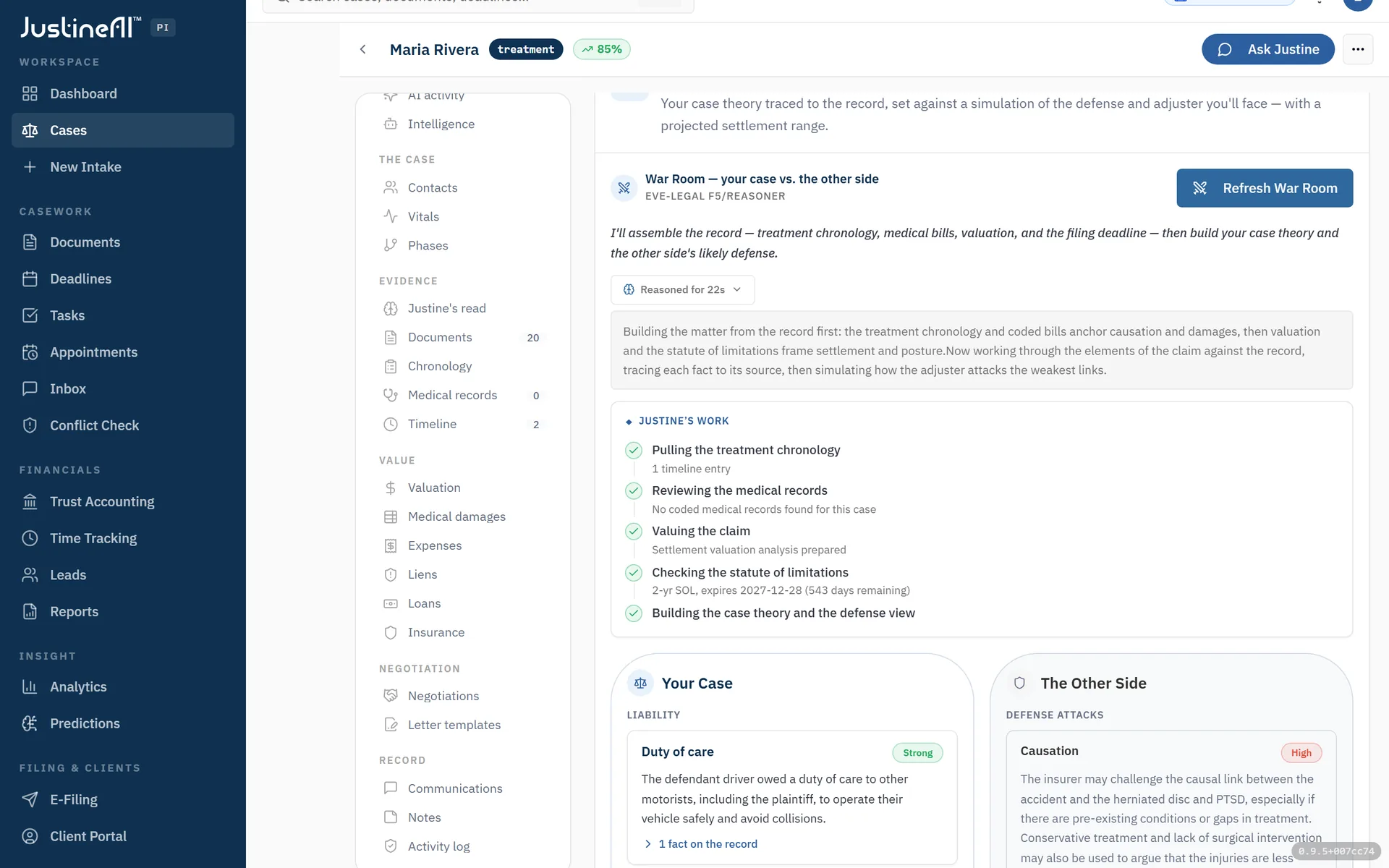
    The daily case auditor runs at 06:00 UTC against every open matter. Flags missed appointments, treatment gaps over threshold, and providers who haven’t reported in the contract window. The treatment chronology is always current.

  4. Status 04Records

    Eight document analyzers — medical, police, insurance, IME, billing, legal, correspondence, evidence — chronologize the case in real time, up to 50,000 pages per matter, all read into one context. The nine-step Curation Layer runs after extraction: OCR Janitor, Provider Canonicalizer, ICD-10/CPT Code Validator, Incident-Date Splitter, Damages Authority Resolver, Encounter Coalescer, Lien Joiner, Composer Migration, and a Curation Report surfaced in the attorney’s Review Panel.

  5. Status 05Demand

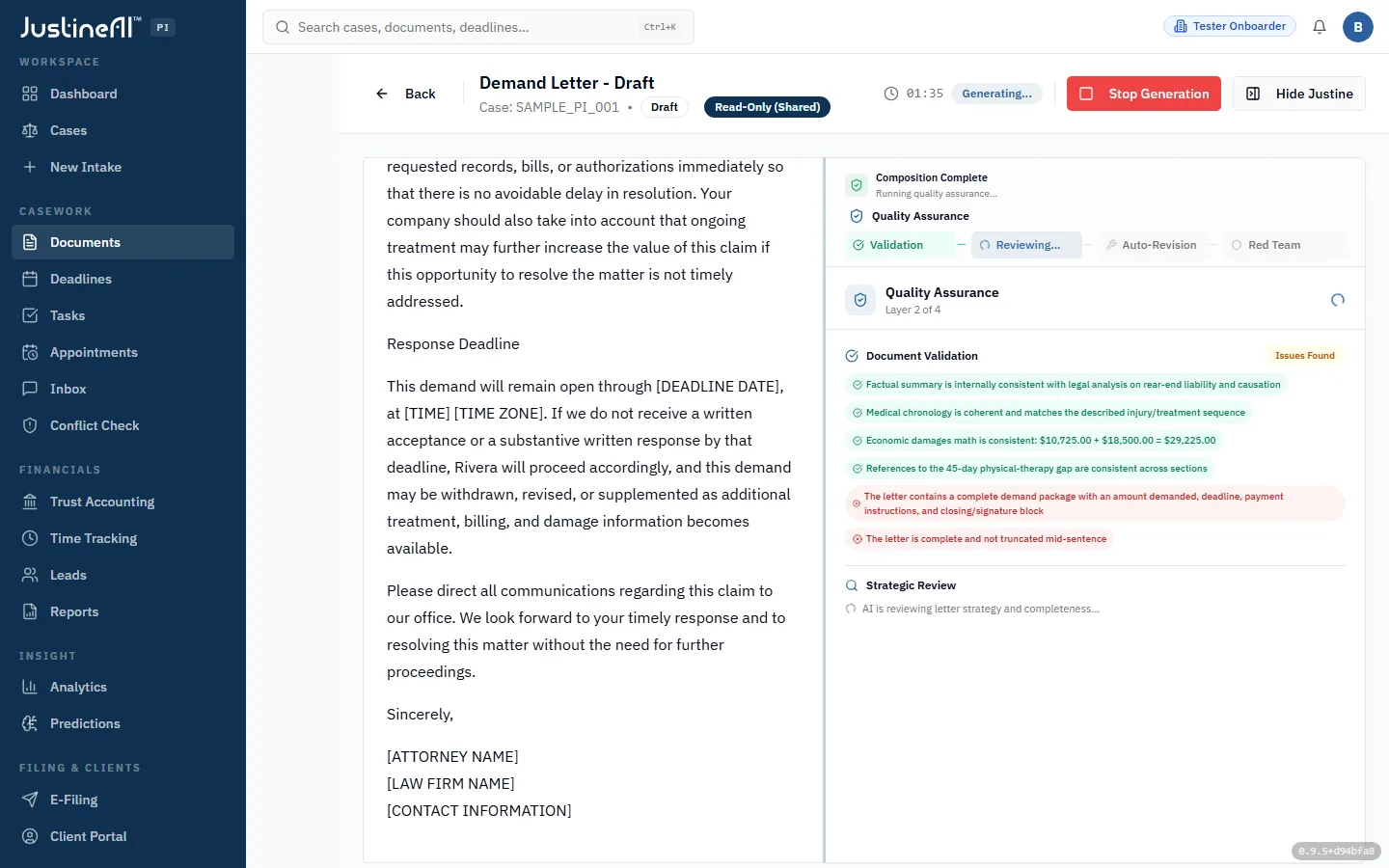
    The four-pass demand-letter pipeline: draft, medical-causation pass, damages quantification, four-layer QA. Every citation is verified against CourtListener. Curated case-law packs for the top ten PI states. The Generate Demand Package CTA assembles the cover letter, Medical Chronology exhibit, and Bill Stack exhibit into a single ZIP for service — best-effort exhibit composition with a manifest the attorney signs off on before send.

  6. Status 06Negotiation

    Counter-offer analysis, adjuster pattern recognition (which adjusters lowball on which injury types, what their cap usually is), Brandt-fees calculator for bad-faith adjacents.

  7. Status 07Litigation

    When the matter goes into suit: complaint and answer drafting, discovery management, deposition preparation, motion-in-limine prep, expert-witness management.

  8. Status 08Settlement

    Settlement-matrix modeling, lien negotiation orchestration (Medicare, Medicaid, ERISA, providers), disbursement statement preparation, client-side settlement explainer.

  9. Status 09Closeout

    Final case file delivery to the client, audit-log export for ethics review, post-mortem analysis for the firm’s internal pattern library. The case is closed; what the firm learned from it isn’t.

The supervisor patternDistinct in the MindHYVE™ portfolio

One Justine. Many stage-specialized sub-agents.

Justine isn’t a single model. She’s a Digital Employee who coordinates stage-specialized sub-agents across the case. The sub-agents aren’t separately branded — they’re facets of the Digital Employee that handles your firm. This is the architecture that makes Mass Tort possible: one Justine, thousands of plaintiff sub-agents in a single reasoning context.

  • Intake sub-agent

    Justine’s Workspace v1.2 — drop documents, watch fields populate with per-field provenance, validator-council confirmation, conflict-confirmation dialogs across sources. Liability vector. Mechanism of injury. Jurisdiction lookup. Statute-of-limitations clock. Coverage discovery. PIP / med-pay / UM/UIM identification. Client-conflict check.

    For example — A passenger in a rear-end collision on the I-5. You drop the police report, the ER intake form, and the registered-owner declaration page into the workspace. The intake sub-agent extracts each field — CA jurisdiction, 2-year SOL clock, at-fault carrier, layered UM coverage — and shows the source page for every extracted value. The validator council confirms the SOL clock and surfaces a single cross-source conflict on the named driver, which you resolve in the conflict-confirmation dialog before assembly.

  • Medical sub-agent

    Provider chronology. Treatment-gap detection. ICD-10 code mapping. IME response. Medical-bill audit. Permanent impairment rating modeling. Causation linkage.

    For example — A 5,000-page record set across nine providers. The medical sub-agent surfaces the 19-day treatment gap that the carrier’s IME will exploit, the two PT notes that contradict the IME’s functional-capacity opinion, and the three records that establish causation to the underlying accident.

  • Valuation sub-agent

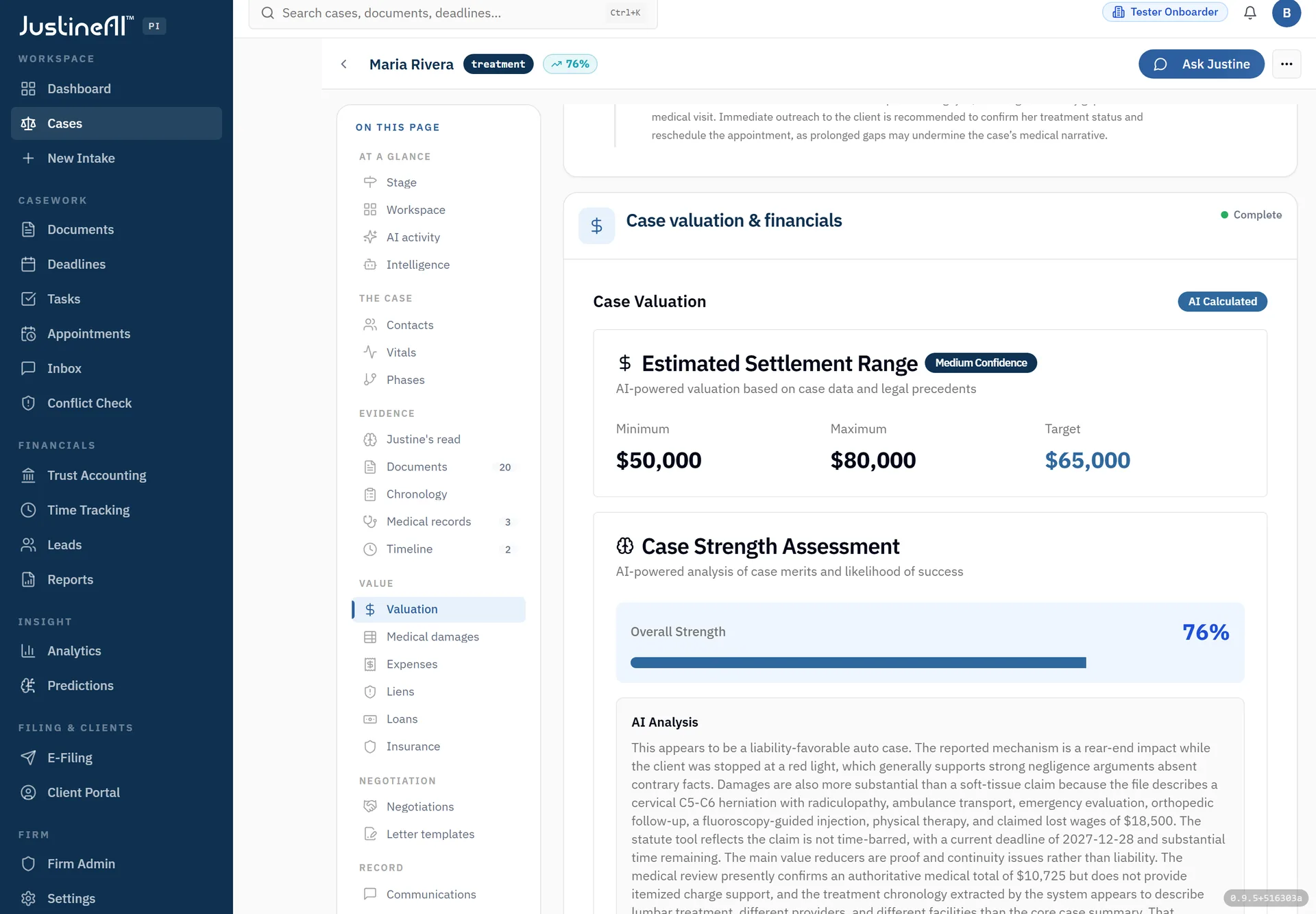
    Special damages tally. General damages comparable analysis. Future-medical cost projection. Policy-limit awareness. Lien total. Jury-verdict comparables for the venue.

    For example — Special damages $87K. General damages comparables for L4-L5 disc herniation in San Diego County run $180K–$320K. Lien total $42K. Policy limit $100K + $250K UM. Pre-suit demand: $385K. Bottom-line authority: $215K.

  • Strategy sub-agent

    Adjuster pattern. Demand framing. Negotiation tree. Mediation positioning. Filing decision. Discovery plan.

    For example — The carrier’s adjuster on this file settles soft-tissue claims under policy limit far more often when the demand leads with future-medical and includes a sworn provider affidavit — a pattern Justine draws from the adjuster’s own history on comparable matters. Justine recommends including the affidavit and structuring the opening number 15% above the projected acceptance range.

Thirty-one capabilities

Thirty-one AI capabilities across the case lifecycle.

Every capability listed is shipped today in the PI edition. Counted per the live feature catalogue — these are the agents, analyzers, and composers in production, not roadmap items. The count refreshes when the live app ships new capabilities (latest reconciliation: 2026-05-19).

  • Justine’s Workspace v1.2. Field-level provenance. Validator council. Liability and coverage discovery.

    Intake & investigation

    • Conversational intake — Justine's Workspace v1.2
    • Per-field provenance to source document
    • Validator council + cross-source conflict confirmation
    • Liability vector reasoning
    • Coverage discovery + policy-limit identification
    • Jurisdiction lookup + SOL tracking
  • Eight document analyzers. Nine-step Curation Layer. Up to 50,000 pages per matter, all in one context.

    Medical & document intelligence

    • Medical-record chronology across providers
    • Police-report analysis
    • Insurance correspondence analysis
    • IME / DME response analysis
    • Medical-billing audit
    • Legal correspondence triage
    • Evidence catalogue + chain-of-custody
    • Treatment-gap detection (daily auditor)
    • Nine-step Curation Layer (OCR Janitor → Curation Report)
  • Four-pass pipeline + four-layer QA. ICD-10/CPT validation. 50-state coverage. Top-10 states curated.

    Demand & negotiation

    • Demand-letter pipeline (4 passes + 4 QA layers)
    • ICD-10 / CPT medical-codes pipeline + QA layer
    • Case-valuation modeling
    • Settlement-matrix analysis
    • Adjuster pattern recognition
  • One-click bundle: cover letter + Medical Chronology exhibit + Bill Stack exhibit + audit row.

    Demand package assembly

    • Demand Package orchestrator (one-click bundle)
    • Medical Chronology Composer (Exhibit A PDF)
    • Bill Stack Composer (Exhibit B PDF)
  • Long-context reasoning across the full case file.

    Litigation & discovery

    • Deposition preparation + analysis
    • Discovery management
    • Expert-witness research and management
    • Motion-in-limine preparation
  • Lien orchestration. Audit log. Pattern library.

    Settlement & closeout

    • Lien negotiation orchestration
    • Settlement disbursement preparation
    • Audit-log export (ethics-grade)
    • Post-matter pattern library
The reasoning, shownAttorney-attested work product

This is the reasoning — not just the workflow.

The case-reasoning quality that used to be locked inside elite firms, on every matter. These are the kinds of findings Justine surfaces on a real file — the contradictions, the comparables, the deadlines a busy practice would miss — each one presented with its evidence, its confidence, and the source behind it, for your review.

  • Intake reasoning

    Justine found — Drop the police report, the ER intake form, and the carrier’s declaration page. Justine reads every page, extracts the jurisdiction, the at-fault carrier, and the layered UM/UIM coverage — and shows the source page behind every value, with a validator council confirming the statute clock before assembly.

  • Medical chronology

    Justine found — Across 5,000 pages and nine providers: the 19-day treatment gap the carrier’s IME will exploit, the two PT notes that contradict its functional-capacity opinion, and the three records that establish causation back to the collision.

  • Case valuation

    Justine found — Special damages $87K. Venue comparables for an L4-L5 disc herniation in San Diego County run $180K–$320K. Lien total $42K against a $100K policy plus $250K UM. Pre-suit demand: $385K. Bottom-line authority: $215K.

  • Deposition analysis

    Justine found — Cross-referenced the defendant’s Day-3 deposition against his Day-1 recorded statement and the police report — three inconsistencies on speed and following distance, and a ready cross-examination sequence built from his own prior words.

  • Negotiation strategy

    Justine found — When the demand leads with future-medical and a sworn provider affidavit, this adjuster’s own claim history shows a markedly higher rate of settling soft-tissue cases under policy limit. Justine framed the opening number 15% above the projected acceptance range — with the supporting authority already attached.

  • Viability + deadlines

    Justine found — Scored the matter 85/100 — citing both treating physicians, a clean liability picture, and a statute-of-limitations deadline 21 days out — and surfaced it in the 06:00 briefing alongside the two other matters that need you today.

  • Conflict + citation discipline

    Justine found — Caught a prior representation of the opposing driver before the engagement letter went out. And every statute and case Justine cites is grounded against a verifiable authority on CourtListener — reasoned from real law, never invented.

The AI reasons; the attorney decides.

How firms come on

Three on-ramps. Same Justine.

  • Solo and small (1–5 attorneys)

    Self-serve trial

    14-day free trial. No credit card. Cancel anytime. Onboarding documentation + in-product workflow guidance. For small practices ready to evaluate without a procurement cycle.

    Start a free trial →

  • Mid-size (6–25 attorneys)

    Sales-assisted

    Demonstrated on your matters. Onboarding handled by a JustineAI™ engineer. Migration support from existing case-management software. Configurable to your workflow.

    Talk to our team →

  • Enterprise (25+ attorneys)

    Enterprise procurement

    Custom MSA. DPA negotiation. Optional customer-managed keys. Dedicated tenant isolation. Compliance evidence package. SAML / Microsoft Entra ID single sign-on.

    Talk to procurement →

Founding Firm program

The first 50 PI firms to come on get the Founding Firm rate locked for 24 months — an annual prepay structure with priority access to the WC, MM, MT, IB, and EL editions as they ship. Program details are in development. Contact us to be considered.

Ready when you are

See JustineAI in your practice.

For PI principals, managing partners, and litigation operators evaluating reasoning-grade AI for their firm. Self-serve trial available for solo and small practices; sales-assisted for mid-size and enterprise.