The rest of the site tells you what JustineAI™ does. This is what it looks like doing it — captured from the working product, with synthetic demonstration matters (no client information). One reasoning core, six editions: Personal Injury and Workers’ Comp (applicant-side; California, Georgia and Texas) are in market and shown here; each other edition’s gallery follows as it ships.
Personal Injury — in market
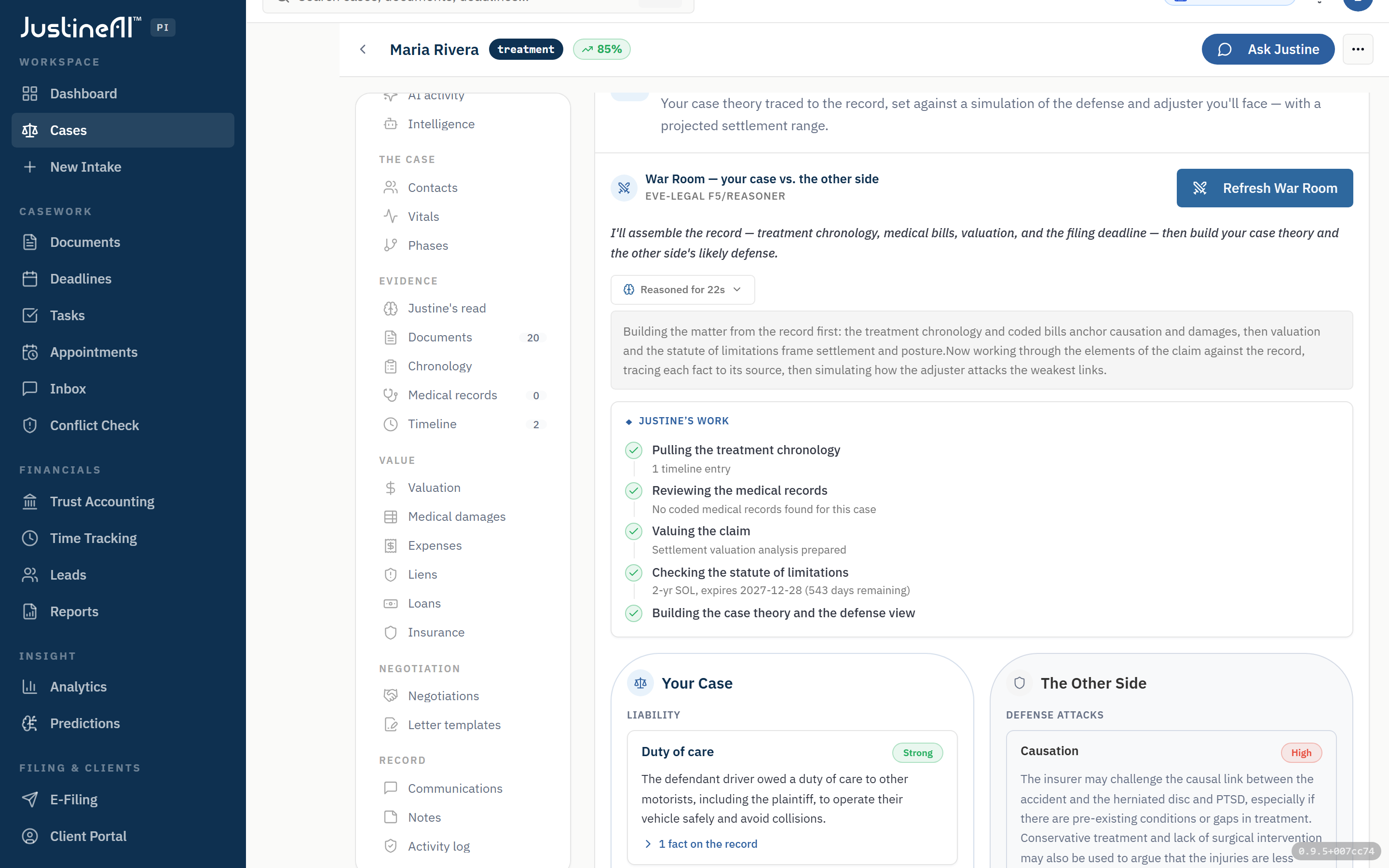
The War Room
Both sides of the case, before the other side.
pi.justinegrid.ai
Justine traces your case theory to the record — each element linked to a fact on file — and, right beside it, simulates the defense and the adjuster: the attacks, the weak points, the posture. A settlement range, and authorities checked against CourtListener. You read the counter-argument before you’re in the room.
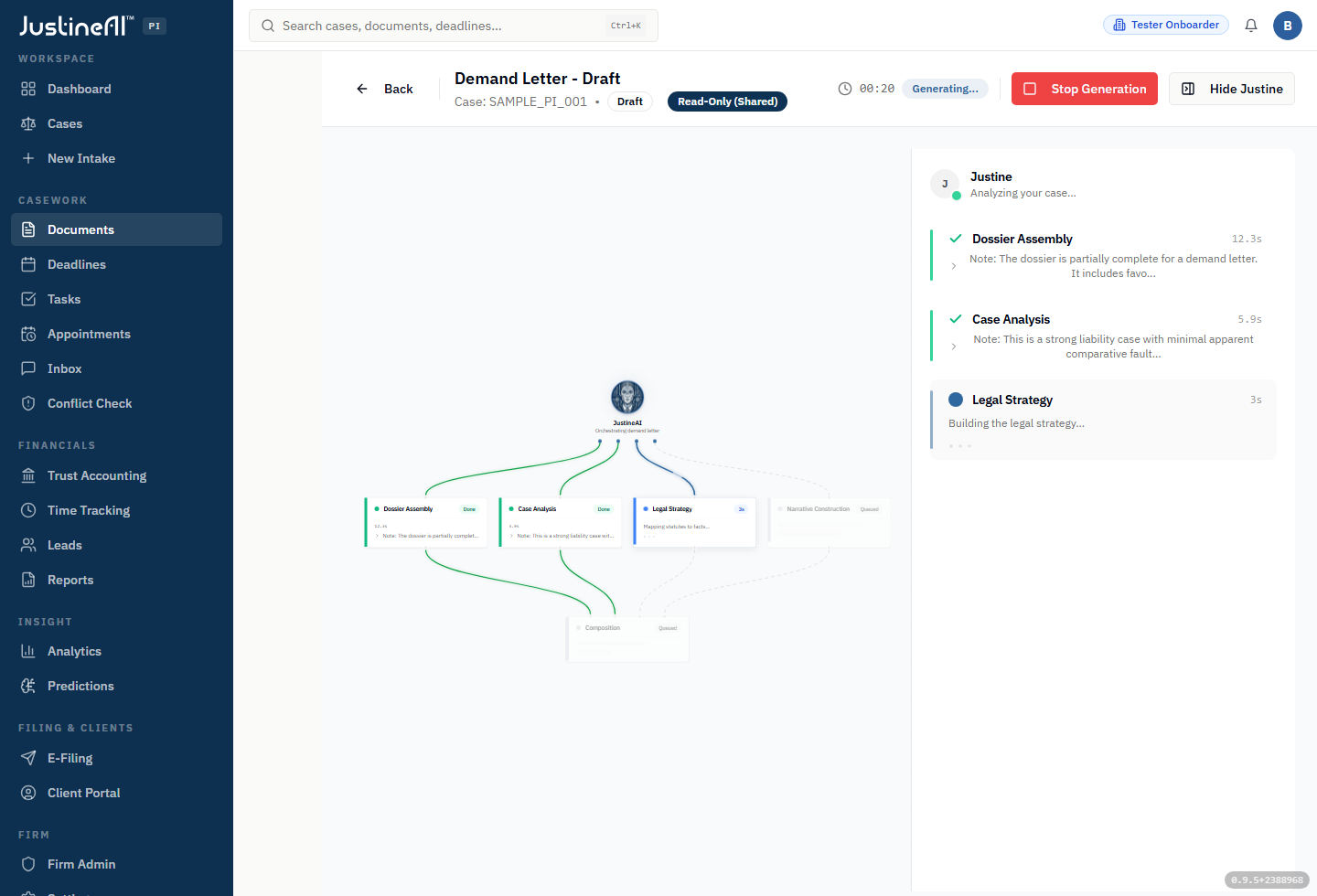
The demand-letter pipeline
Watch the demand letter reason itself into existence.
pi.justinegrid.ai
Justine drafts as a multi-pass agent — assembling the dossier, analyzing liability, building the legal strategy, constructing the narrative — each pass reasoning in the open and grounded in the record before a word of prose is written. You watch the thinking, not a spinner.
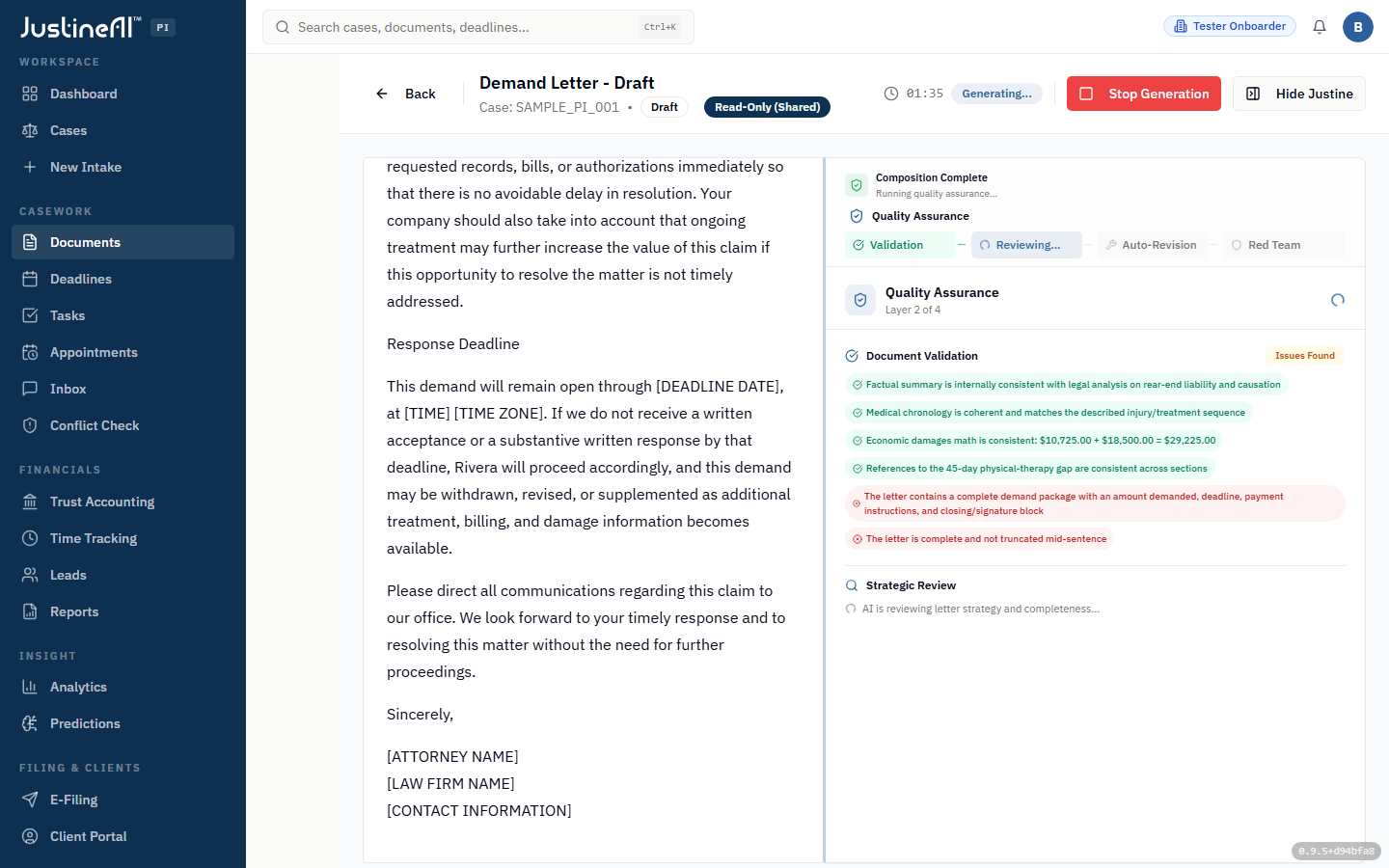
Drafted, then stress-tested
Every letter survives the other side before it reaches you.
pi.justinegrid.ai
As the letter composes, a four-layer quality pass runs live: validation of the damages math, chronology, and internal consistency; a senior-attorney strategic review; targeted auto-revision; and a red team that plays the defense adjuster. The draft you open has already been through the gauntlet.
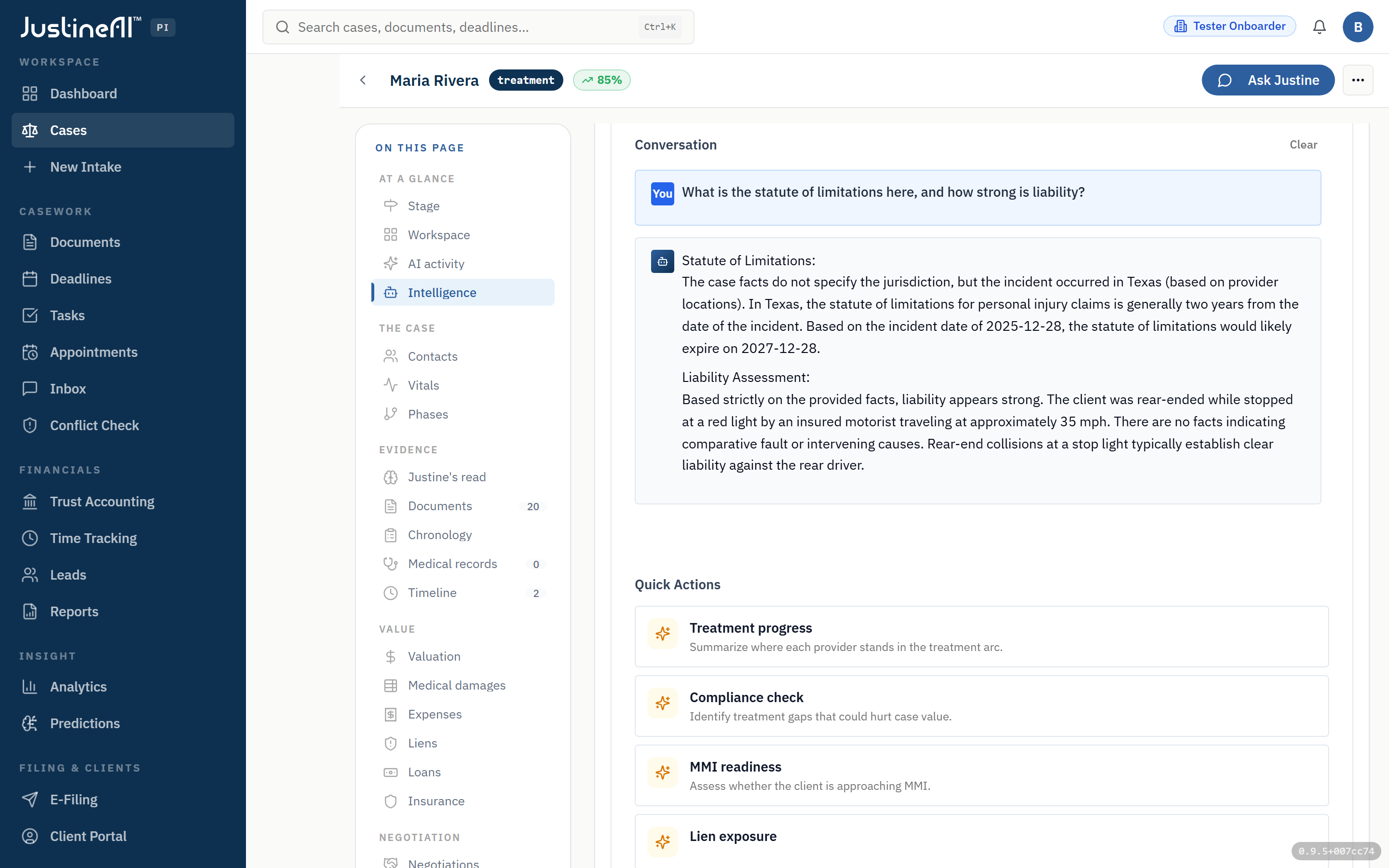
Ask Justine
Ask a question. Watch her reason, and cite.
pi.justinegrid.ai
Justine plans, reasons, and calls grounded legal tools — statute-of-limitations, valuation, medical chronology, citation verification — then answers in the matter’s own context. You steer; you attest.
Grounded, or it says so
She reasons from the record — and tells you when it’s silent.
pi.justinegrid.ai
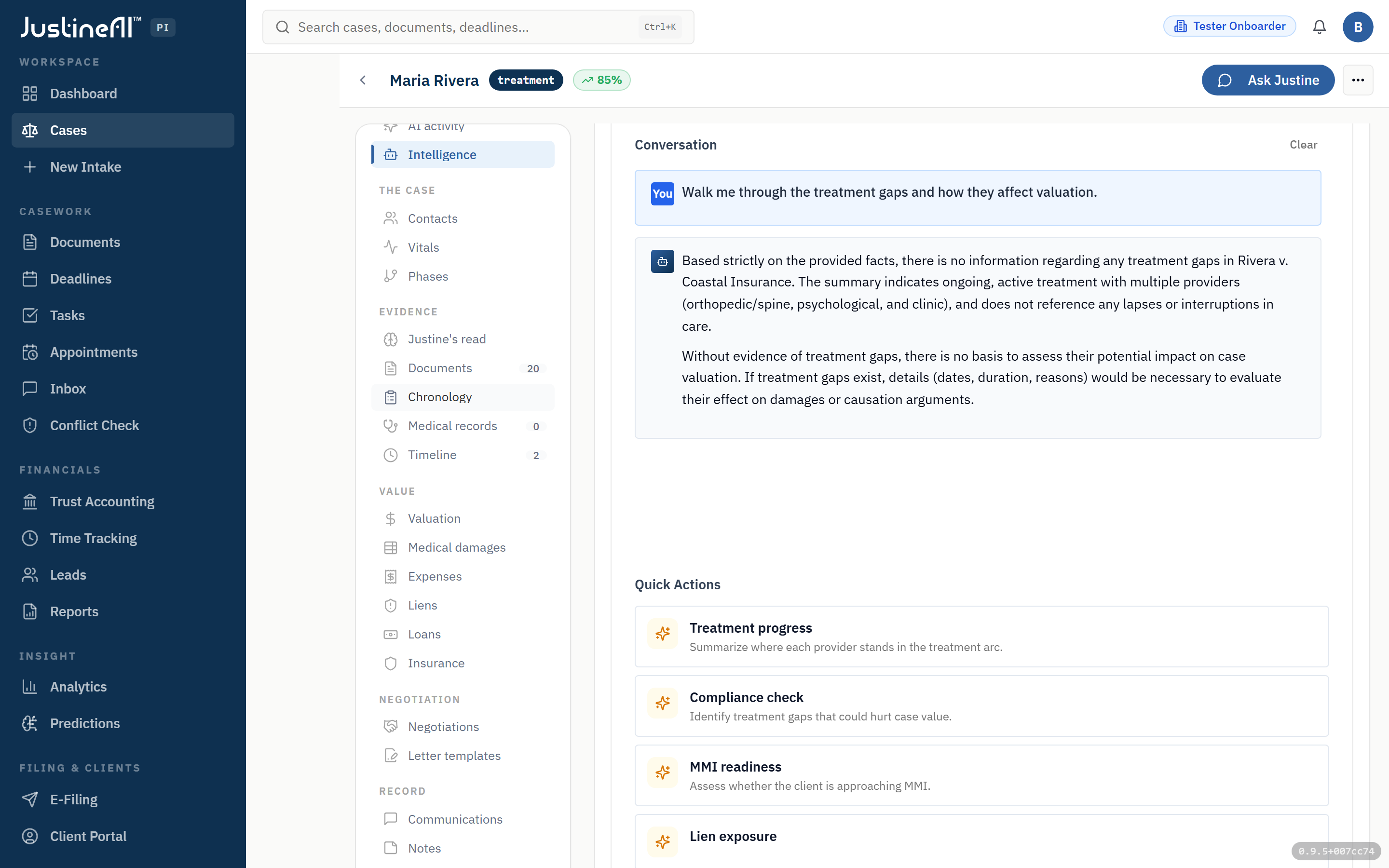
Asked about treatment gaps the file doesn’t document, Justine says so plainly instead of inventing them: “without evidence of treatment gaps, there is no basis to assess their impact.” No hallucinated facts, no invented case law.
The matter workspace
One matter. One reasoning context.
pi.justinegrid.ai
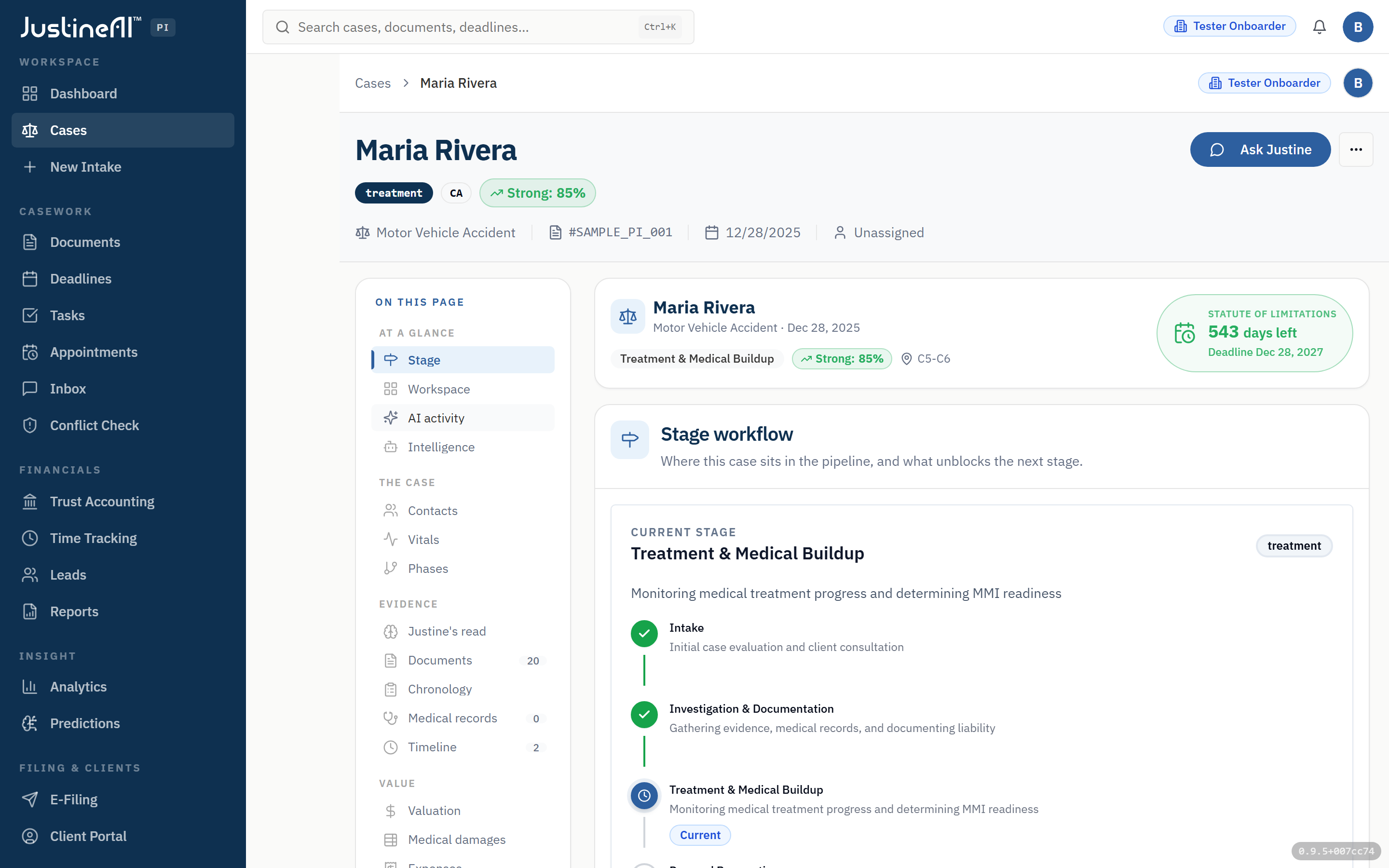
Intake through settlement in a single, matter-centric workspace — essentials, stage workflow, evidence, valuation, and Justine’s reasoning, all in one place.
The medical ledger
Every provider, every visit, every code.
pi.justinegrid.ai
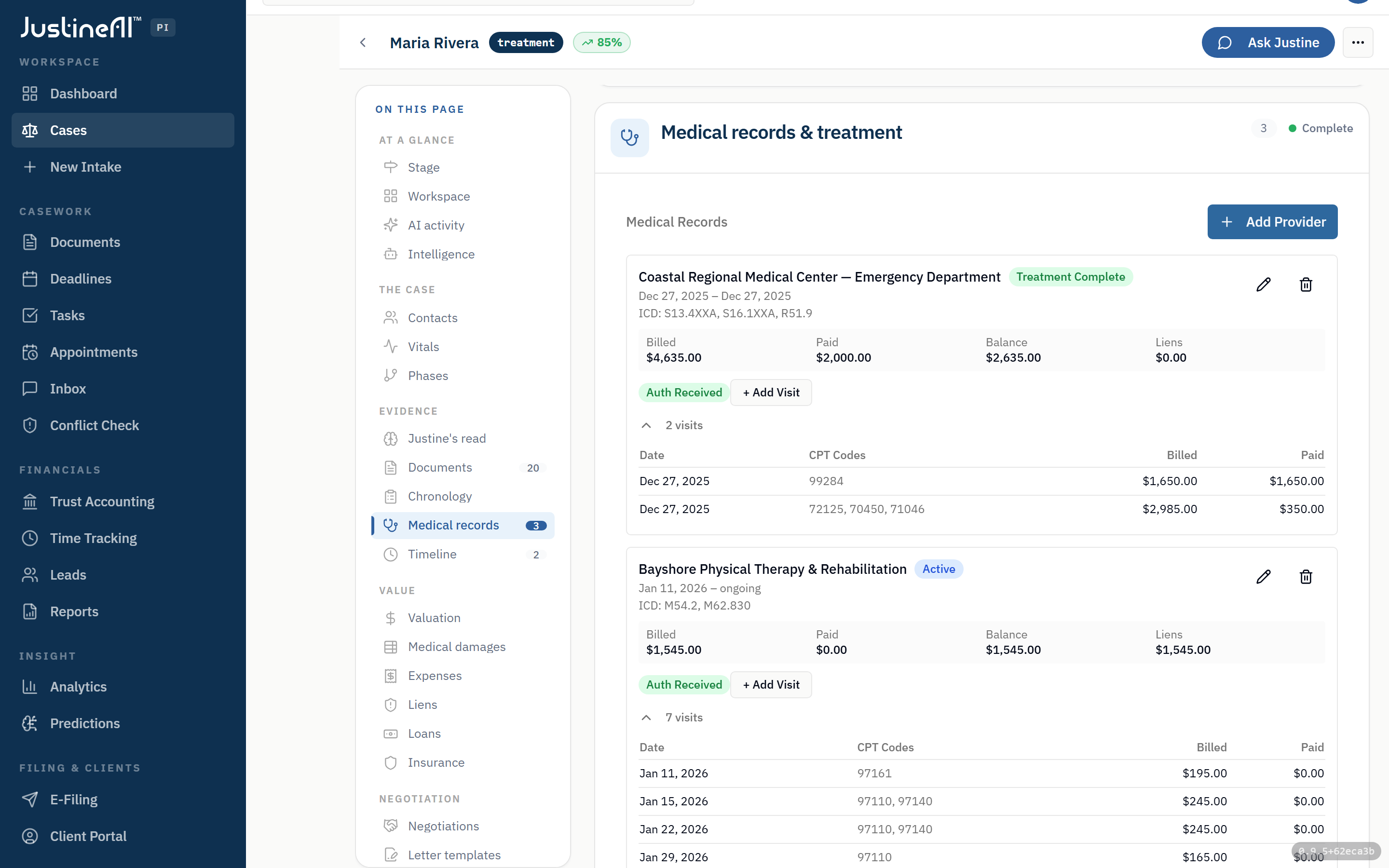
Each treating provider with its ICD-10 diagnoses and per-visit CPT lines — billed, paid, balance, liens, and authorization status. The specials that drive settlement value, organized the way an adjuster reads them.
Valuation & case strength
A number — and the reasoning behind it.
pi.justinegrid.ai
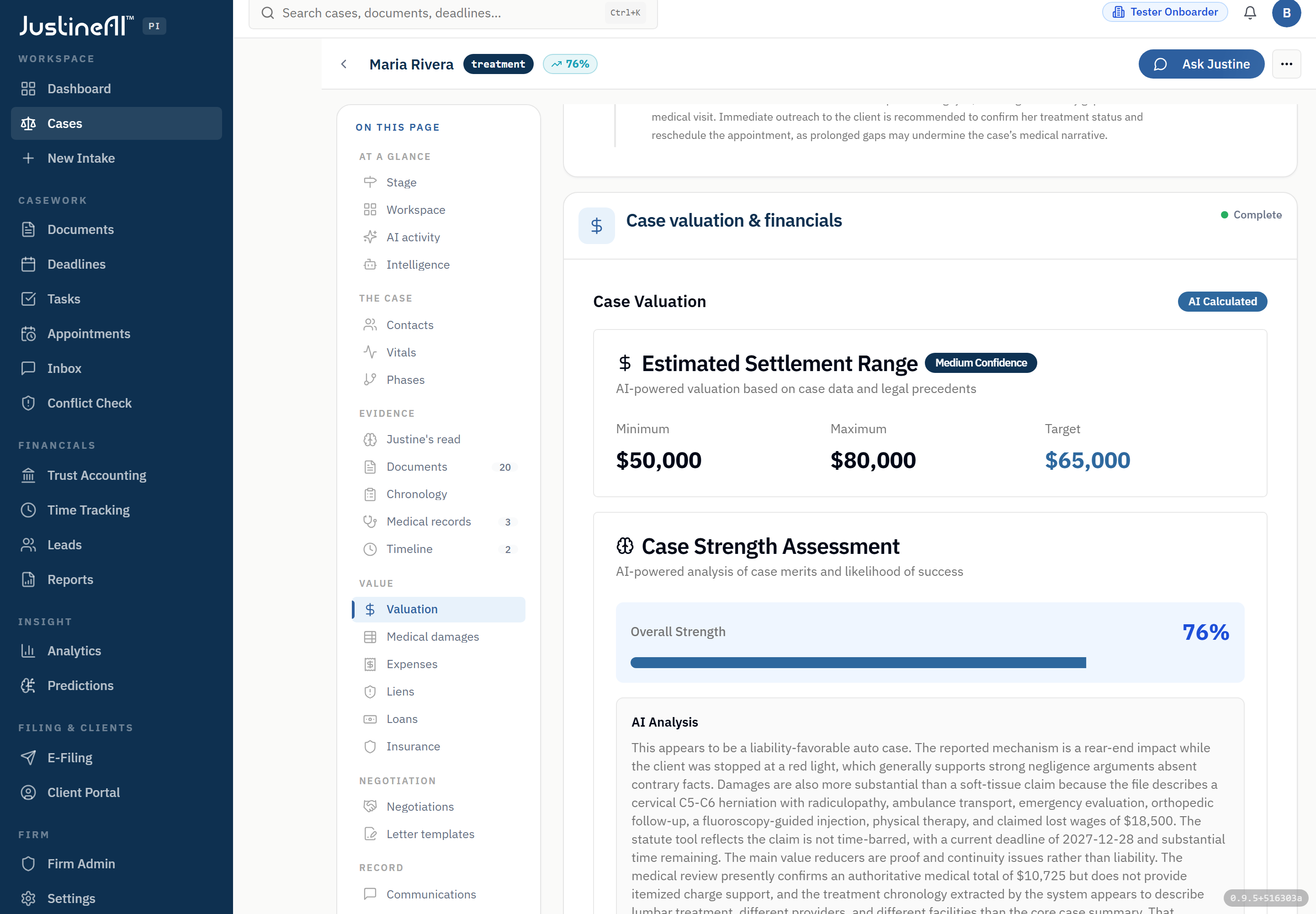
An AI-calculated settlement range and a case-strength score, each grounded in the record and the governing law: liability, the cervical injury, the verified medical specials, the statute of limitations, and the treatment-gap risk the defense will raise. Justine reasons over the matter — and shows her work — rather than guessing.
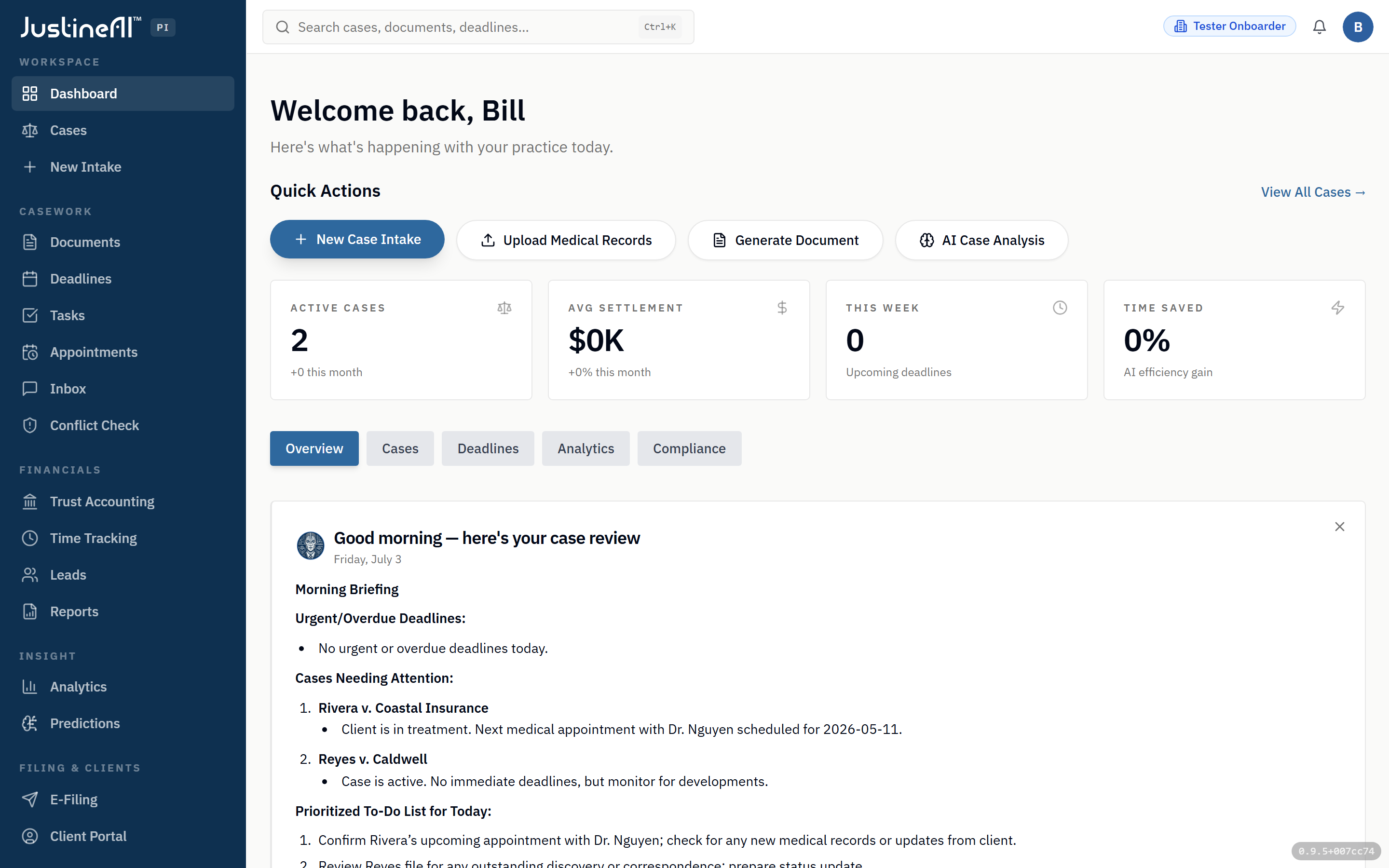
The dashboard
Your practice, read overnight.
pi.justinegrid.ai
Justine works the caseload continuously — a daily review that flags the treatment gaps, deadlines, and risks that move a matter, so you start the day on the case that matters.
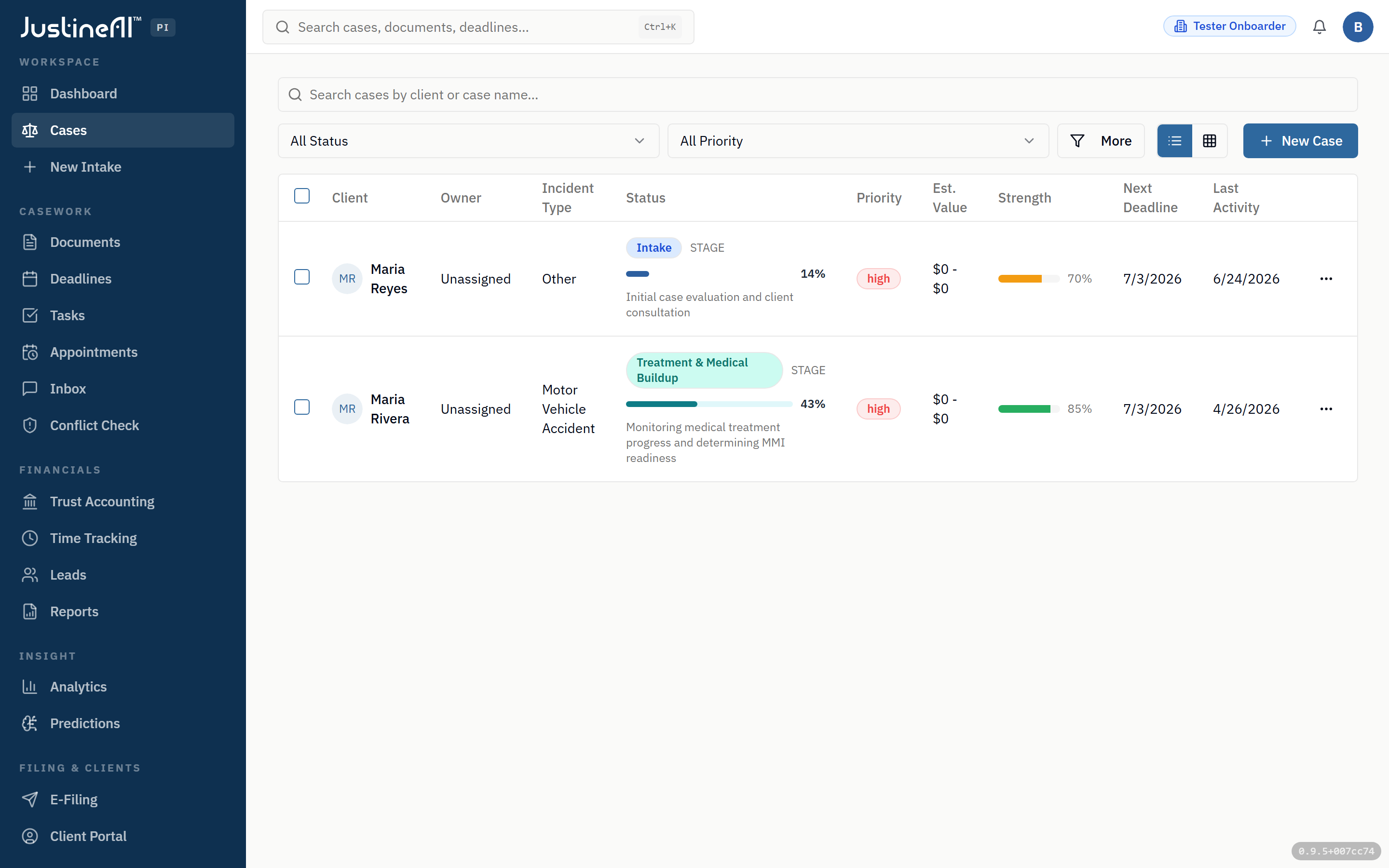
The caseload
The whole portfolio, at a glance.
pi.justinegrid.ai
Every matter with its stage, case-strength read, priority, value, and next deadline — the firm’s book of business in one view.
Workers’ Comp — applicant-side; California, Georgia and Texas — in market
The same reasoning core, calibrated to California workers’ comp: the permanent-disability Value Engine, apportionment reasoning under Escobedo and Almaraz/Guzman, the QME read, the Deadline Guardian, and C&R-versus-Stips settlement math. Captured from the live product on a synthetic demonstration matter — the ratings and dollar figures are projections the attorney verifies, and Justine’s work is analysis for the attorney, not legal advice.
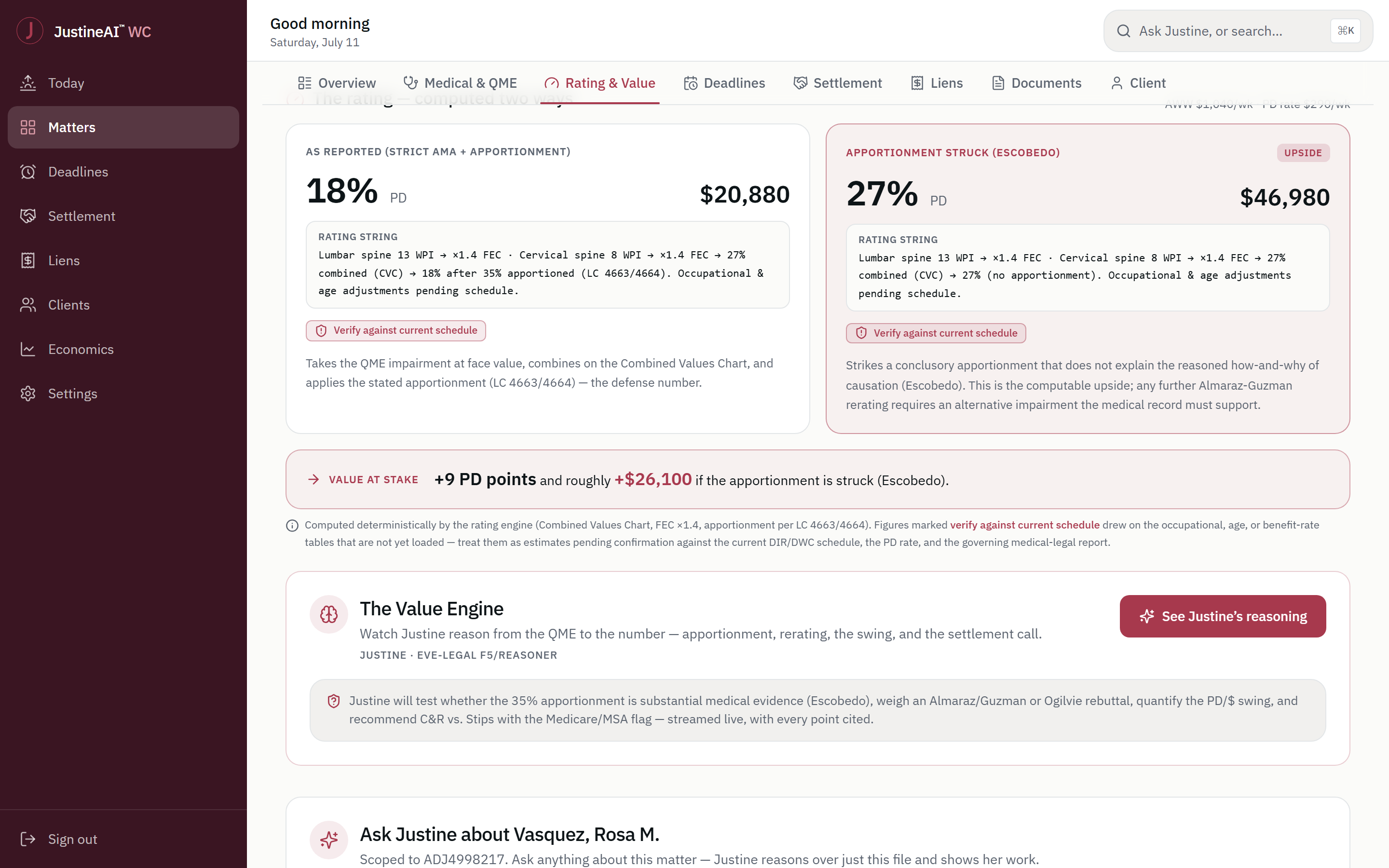
The Value Engine
The permanent-disability number, computed two ways.
wc.justinegrid.ai
Justine rates the claim as reported — strict AMA with the QME’s 35% apportionment — and, right beside it, the rebutted path with that apportionment struck under Escobedo, so the swing is explicit: here roughly +9 PD points and +$26,100. The rating strings (WPI → FEC → Combined Values Chart, LC 4663/4664) are shown in full, and every figure is flagged to verify against the current DIR/DWC schedule and PD rate — projections the attorney confirms, not a final award.
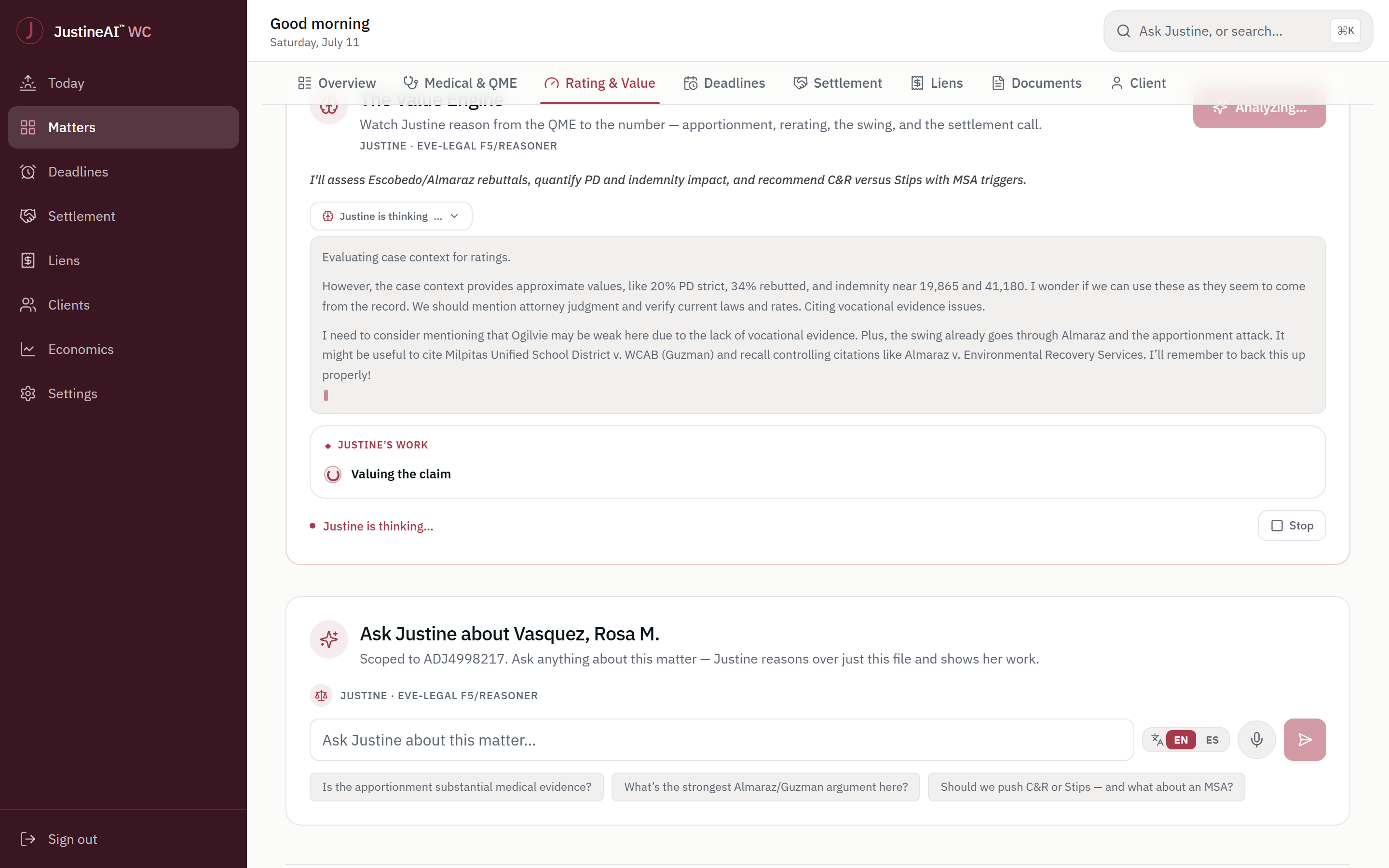
Apportionment, reasoned in the open
Watch her test the apportionment — live.
wc.justinegrid.ai
Ask for the reasoning and Justine streams it: is the QME’s 35% apportionment “substantial medical evidence,” or conclusory and vulnerable under Escobedo? She weighs an Almaraz/Guzman rerating, questions whether Ogilvie is even available on this record, quantifies the swing, and works toward a C&R-versus-Stips call — authorities cited as she goes. You watch the thinking, not a verdict; the attorney decides.
The matter workspace
One claim. One reasoning context.
wc.justinegrid.ai
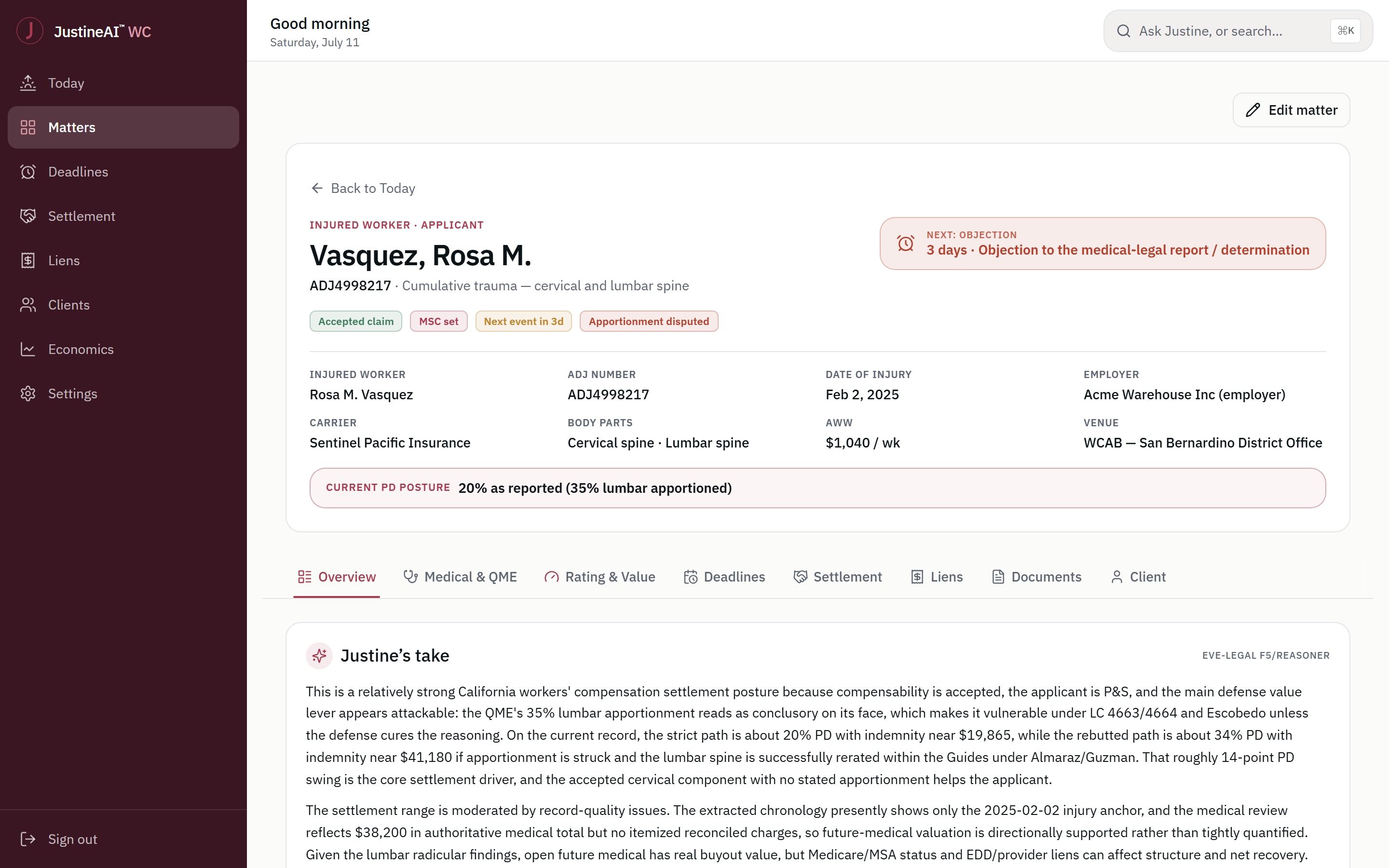
Every workers’-comp essential on one applicant-side matter — worker, ADJ, date of injury, carrier, body parts, average weekly wage, venue, PD posture, and the next statutory deadline — with Justine’s take reading the strict path against the rebutted path and naming the core settlement driver. Intake through settlement in a single, matter-centric view, on a synthetic demonstration matter.
Medical & QME — Justine’s read
The QME, read the way the other side will read it.
wc.justinegrid.ai
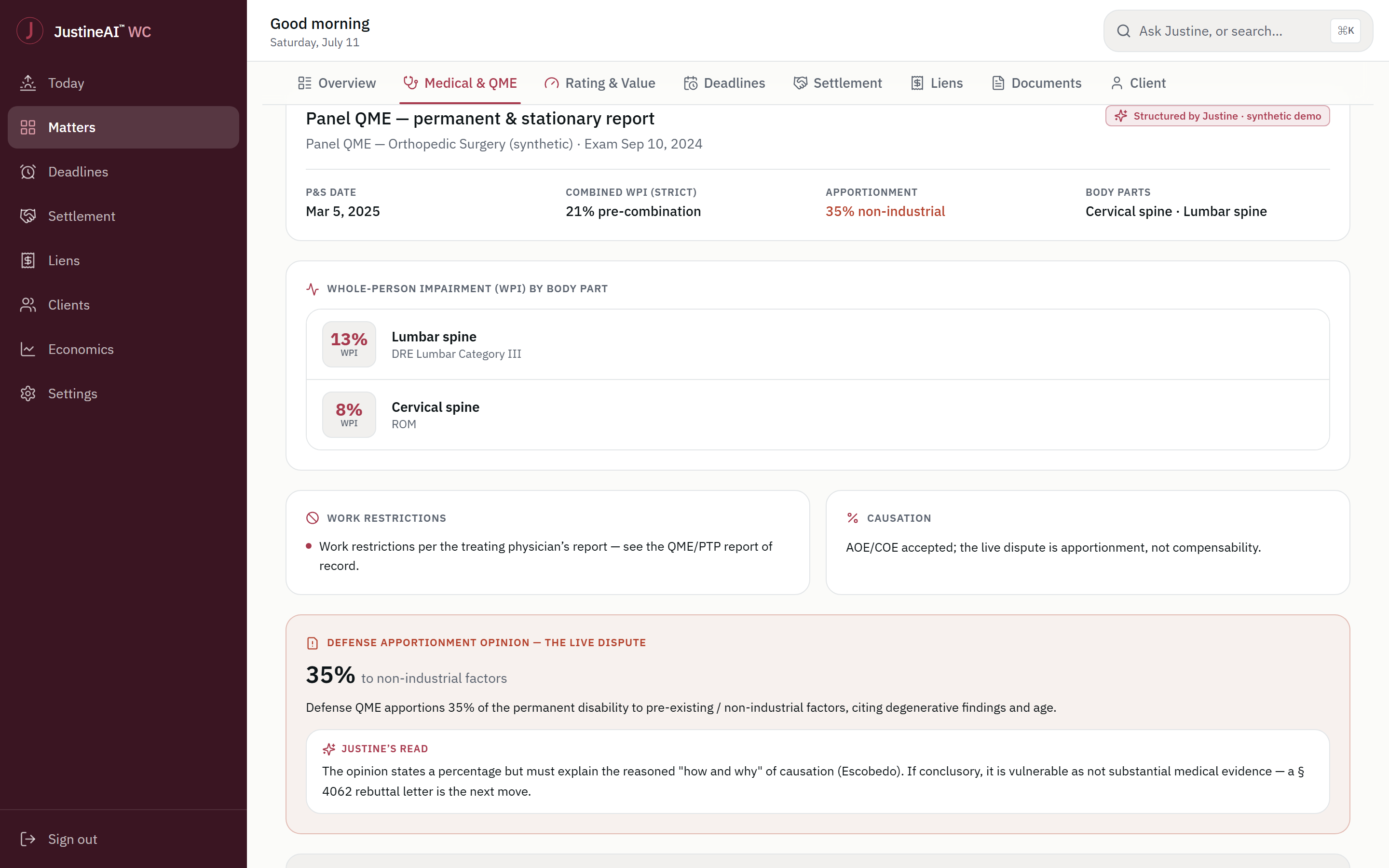
Justine structures the panel QME’s P&S report — whole-person impairment by body part, causation, work restrictions — and isolates the live dispute: the defense’s 35% non-industrial apportionment. Her read is grounded and blunt: a percentage that doesn’t explain the reasoned “how and why” of causation is vulnerable under Escobedo, so a §4062 rebuttal is the next move. Analysis for the attorney — not a medical opinion.
Settlement — C&R vs. Stips
Net-to-client, after the fee and the liens.
wc.justinegrid.ai
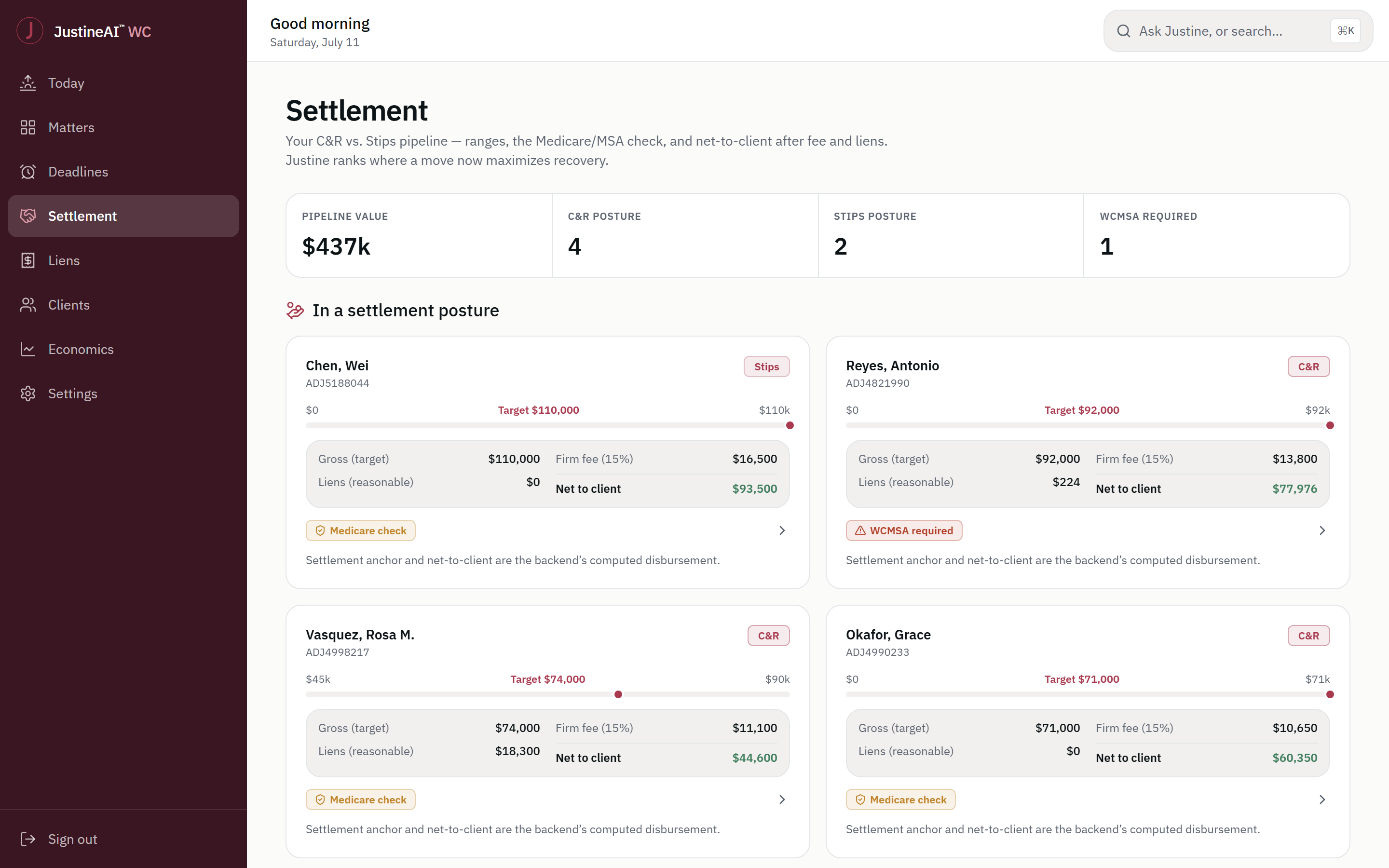
The book’s C&R-versus-Stips pipeline: for each matter, the settlement target, the 15% firm fee, reasonable liens, and the resulting net-to-client — the number the injured worker actually feels. Files that implicate Medicare carry a WCMSA flag so the set-aside question is raised before signing — a prompt to analyze, not a set-aside calculation. Anchors are estimates for the attorney to confirm.
Ask Justine — grounded and cited
Ask about the claim. Watch her reason, and cite.
wc.justinegrid.ai
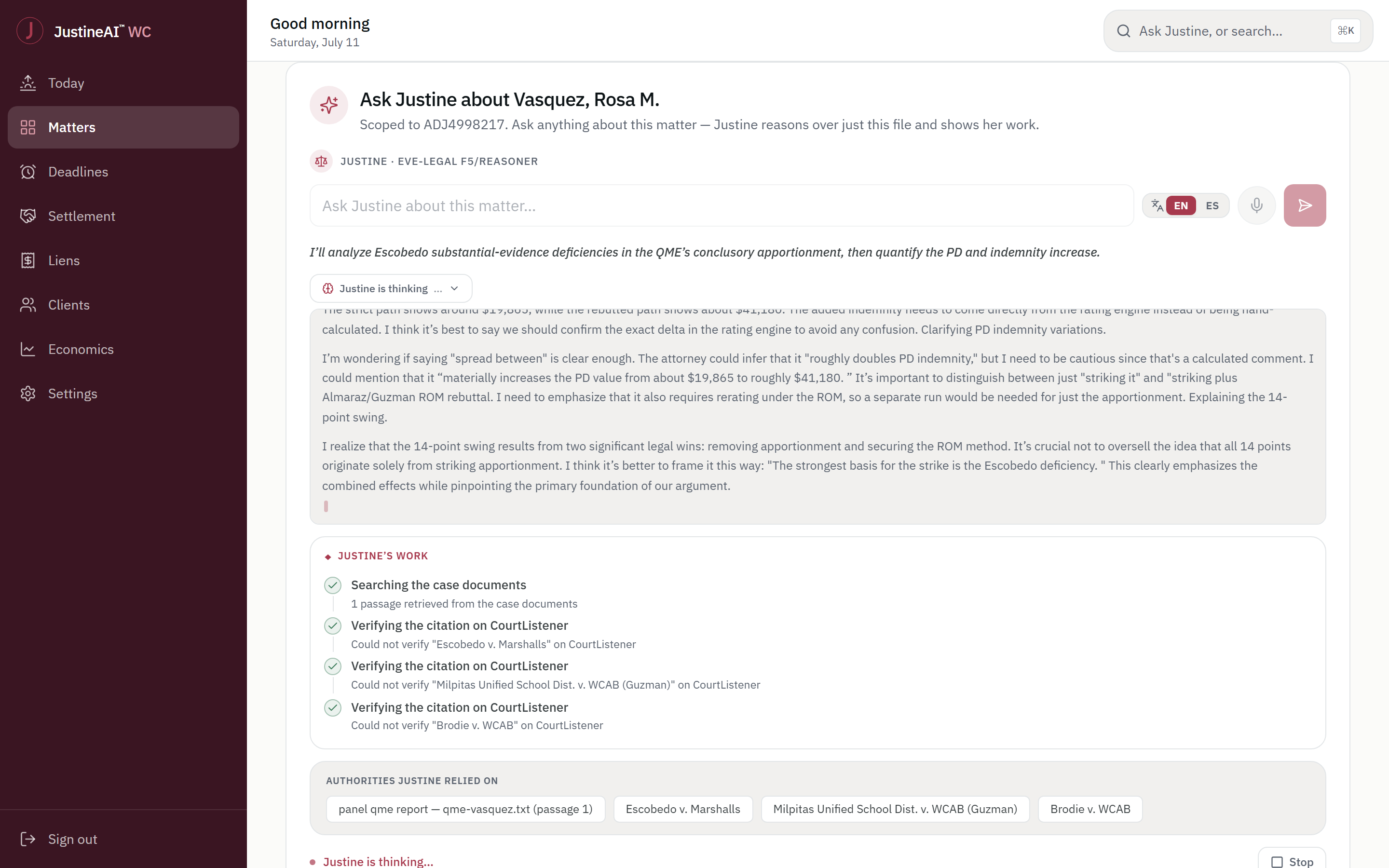
Scoped to one matter, Justine reasons over just that file — here, the strongest basis to strike the QME’s apportionment under Escobedo and the PD and dollar effect if it falls. She retrieves the record, checks her authorities on CourtListener, and shows what she relied on — transparently flagging the citations she could not verify rather than asserting them. You steer; you attest.
The Deadline Guardian
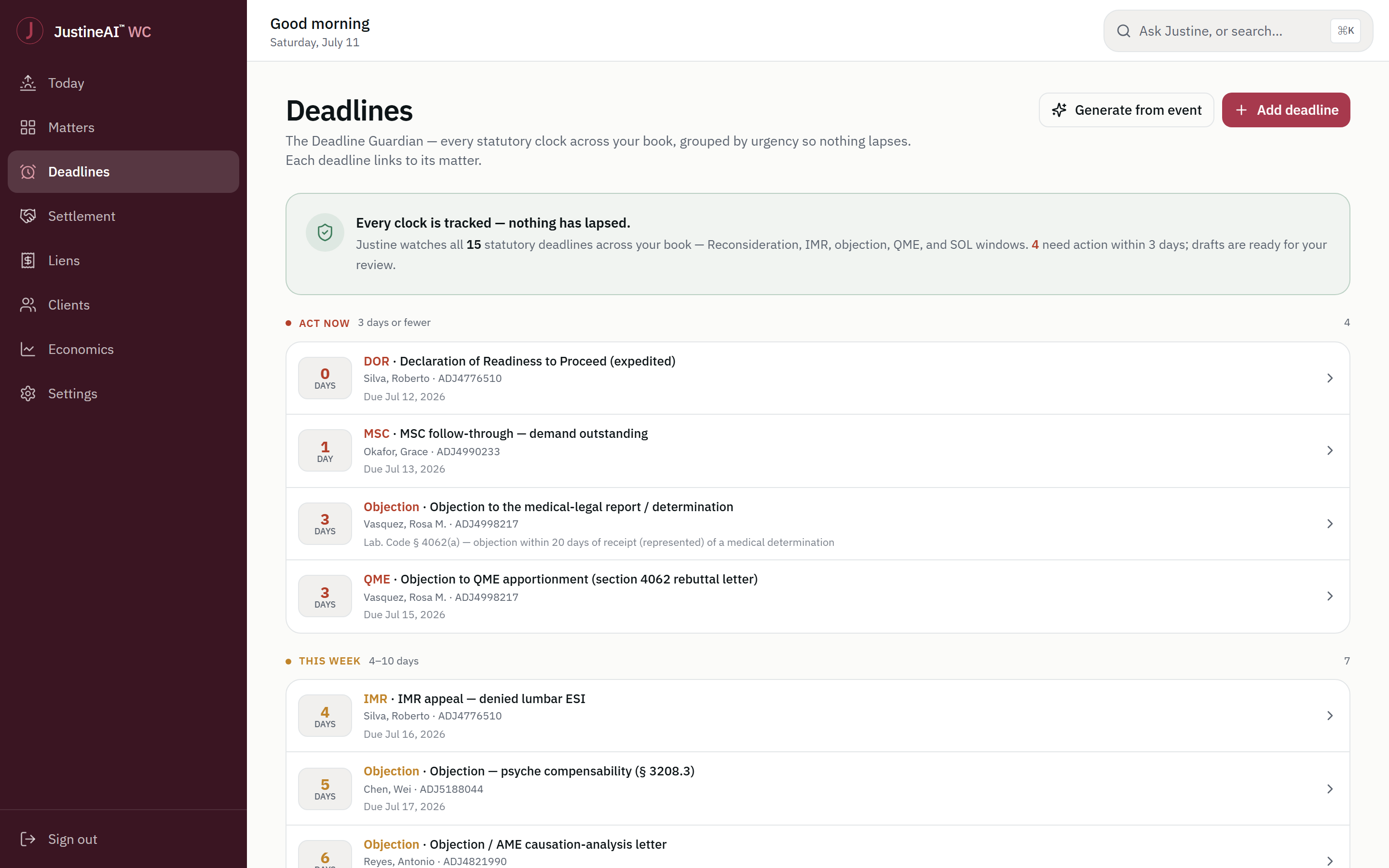
Every statutory clock, watched.
wc.justinegrid.ai
The deadlines that sink a WC file — Reconsideration, IMR, §4062 objection, QME, and SOL windows — tracked across the whole book and grouped by urgency, each linked to its matter with the governing rule (e.g., LC §4062(a)) and days remaining. Justine watches them so nothing lapses; the attorney still owns the calendar.
Today — the morning briefing
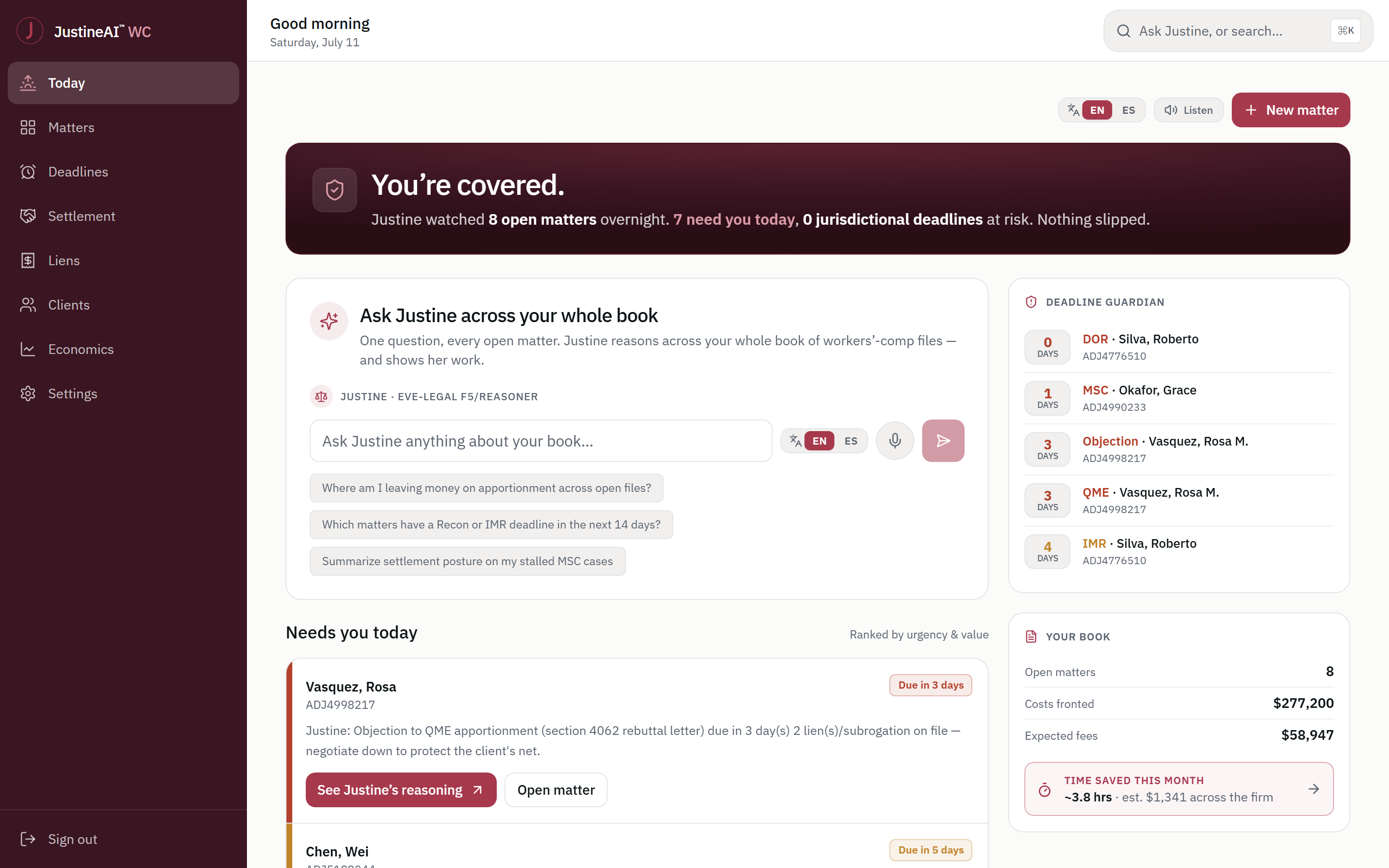
Your book, read overnight.
wc.justinegrid.ai
Justine works the applicant-side caseload continuously and opens the day with what actually needs the attorney — ranked by urgency and value — beside the Deadline Guardian and the book’s economics. You start on the file that moves the claim, not the inbox.
Bilingual client communication
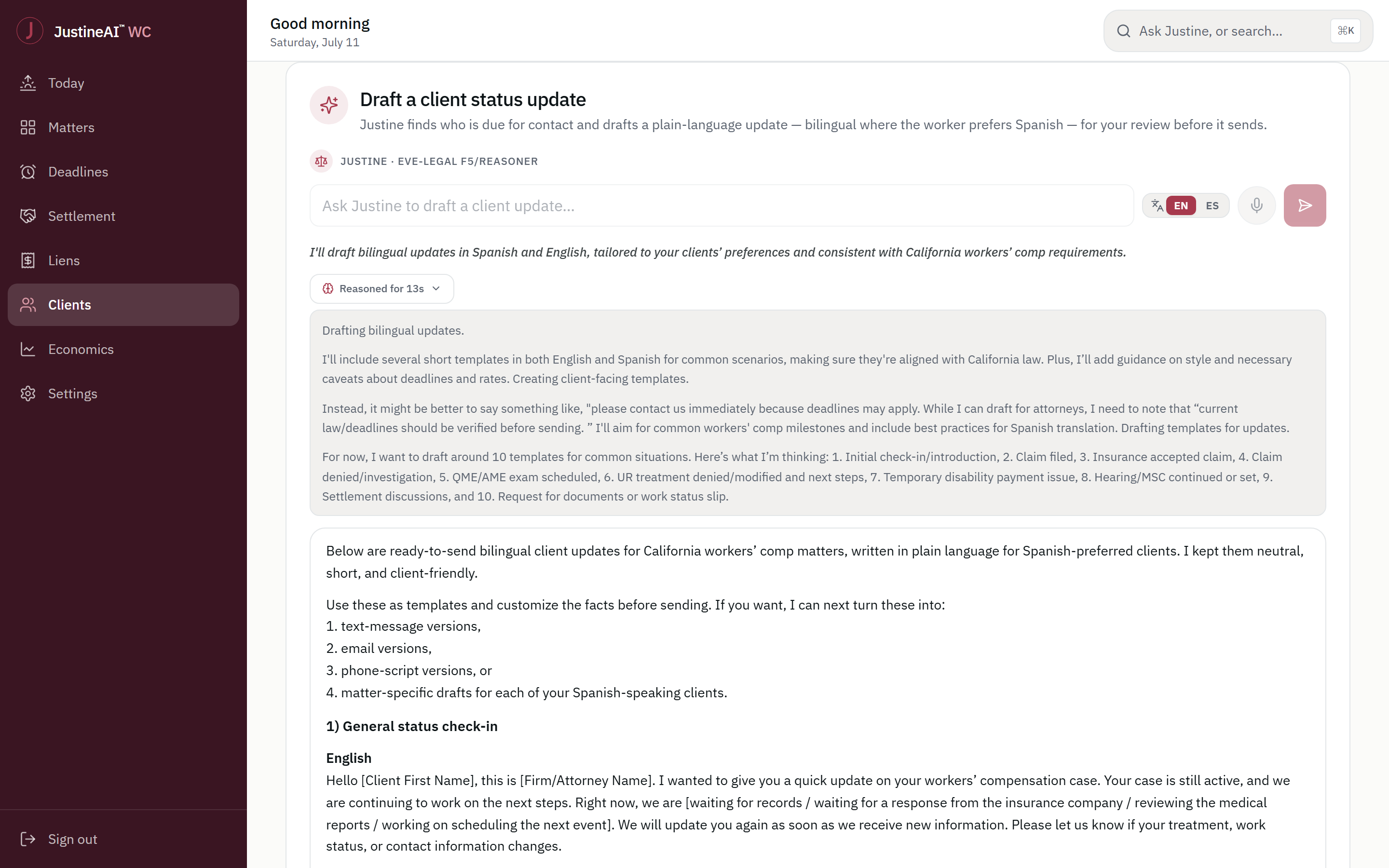
The client update, in the worker’s language.
wc.justinegrid.ai
Injured workers wait in the dark; Justine drafts the plain-language status update — bilingual where the worker prefers Spanish — for the attorney’s review before it sends. She keeps it neutral and client-friendly, avoids legal admissions, and notes that the facts and current deadlines must be verified first. A draft for review — never advice to the client.
The economics of the book
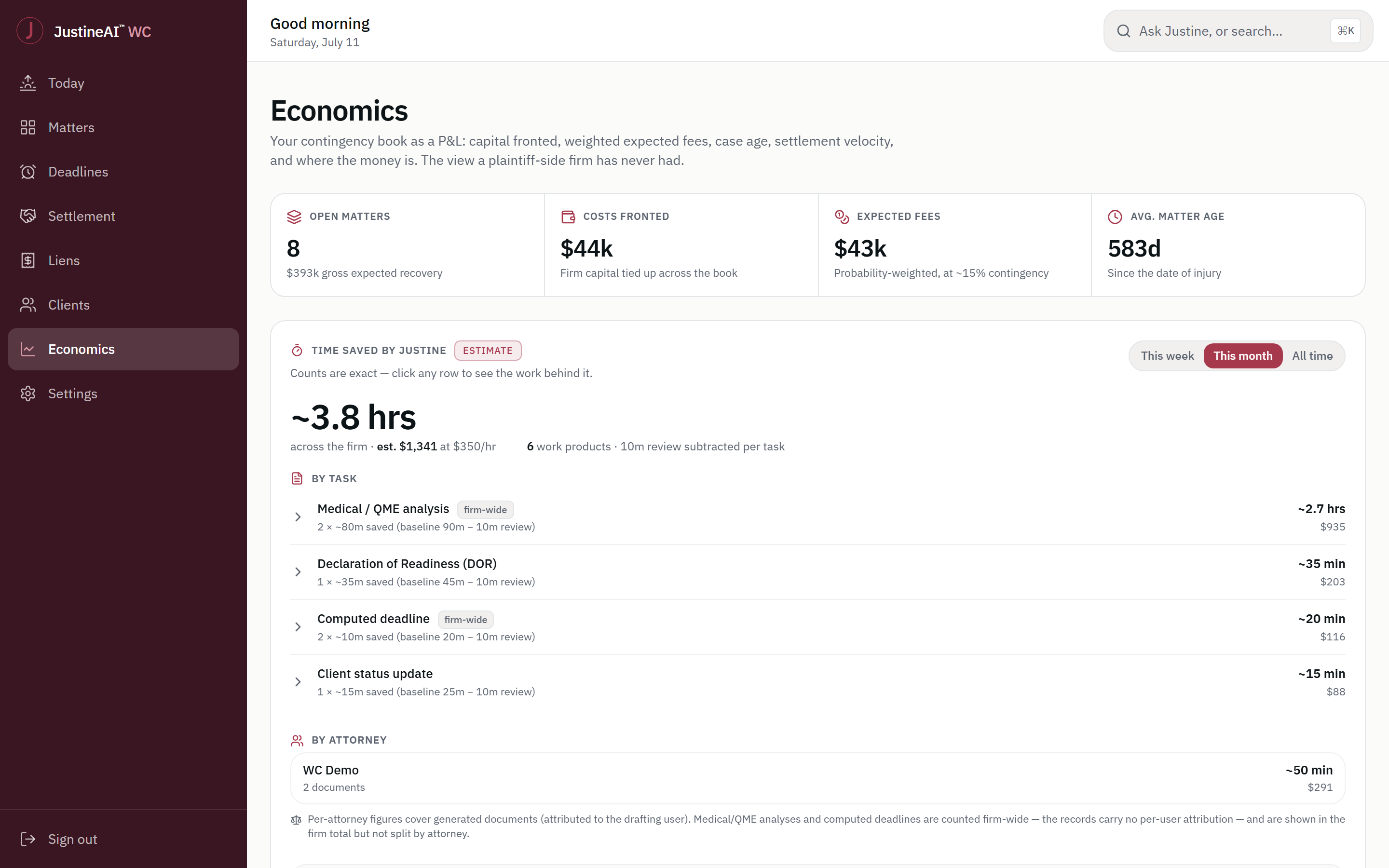
Your contingency book, as a P&L.
wc.justinegrid.ai
Capital fronted, probability-weighted expected fees at the ~15% contingency, average matter age, and settlement velocity — the plaintiff-side view of the book as a profit-and-loss. Alongside it, an estimate of the hours Justine saved, itemized by task, with review time subtracted. Estimates for planning, not billing.
More editions on the way
The same reasoning core, calibrated to each practice. Each edition’s gallery populates when the edition ships — we don’t show a screenshot of a system that isn’t live yet.